
Rokz Clients
Rokz Clients are the core infrastructure primitive of Rokz Protocol.
Without Rokz Clients, Rokz is only a coordination thesis. With Rokz Clients, the protocol becomes executable infrastructure.
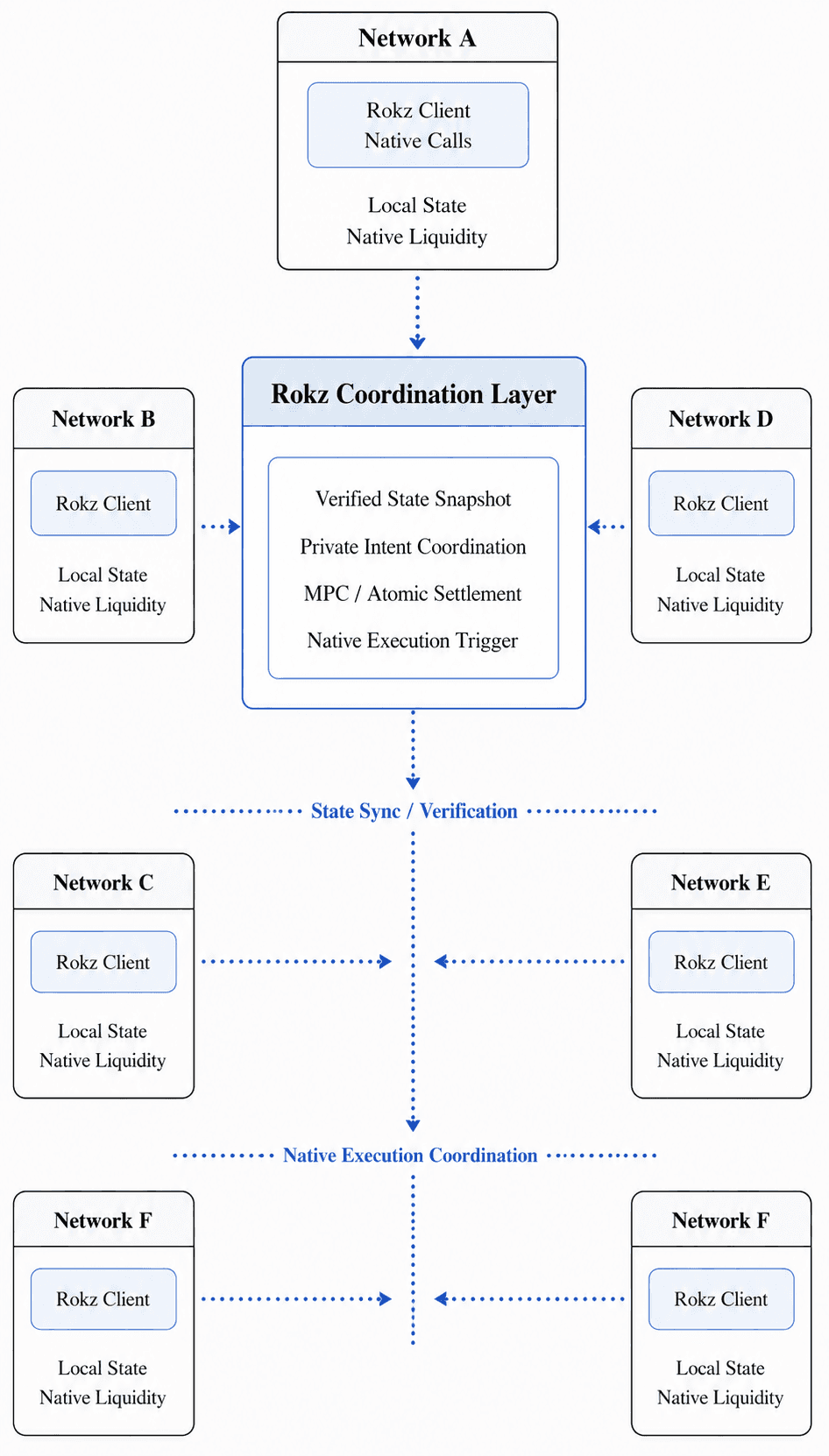
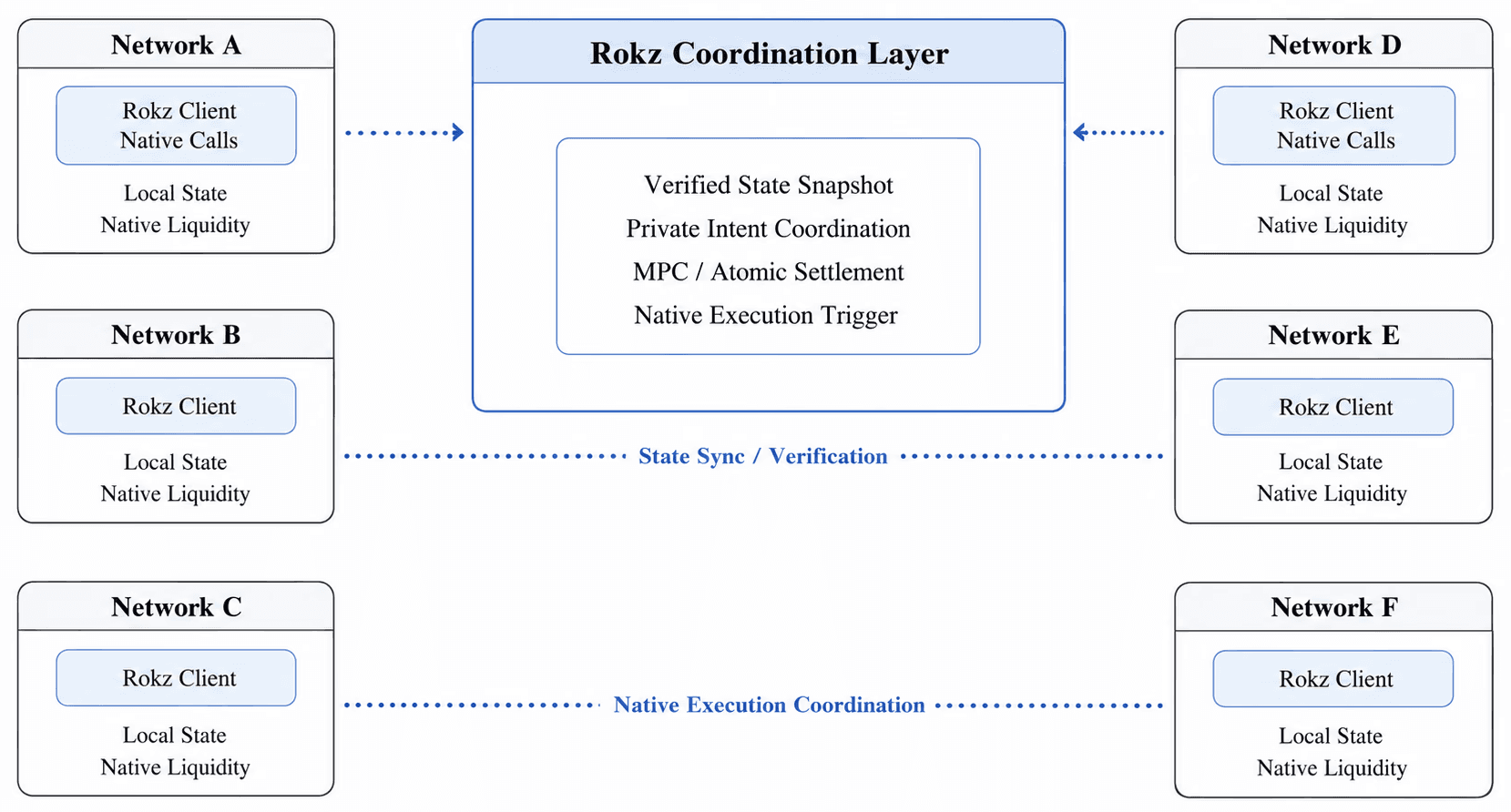
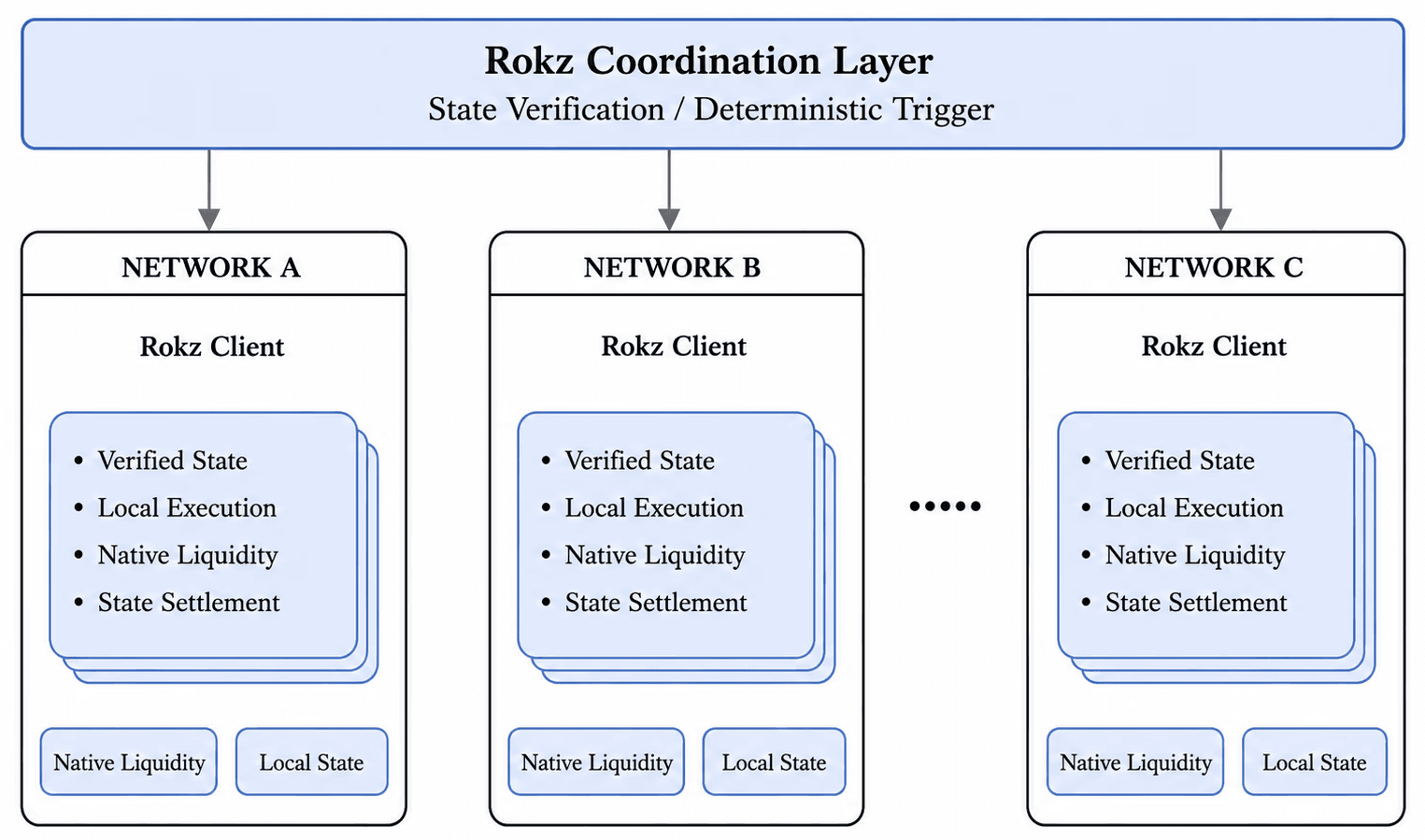
Rokz Clients function as local execution infrastructure inside each supported network. They read blockchain state, verify liquidity, synchronize state, execute transactions locally, and coordinate settlement.
They act as:
The reason Rokz Clients matter is that deterministic cross-network execution cannot be achieved from a centralized abstraction layer alone. The protocol needs local execution presence inside each network.
What Rokz Clients Are
Rokz Clients are distributed local execution engines deployed across supported blockchain environments.
A Rokz Client acts locally inside its network. It retrieves real-time state, checks liquidity depth, validates execution constraints, observes local transaction conditions, interacts with native smart contracts, and coordinates with other Rokz Clients to produce synchronized cross-network execution.
Core Functional Model
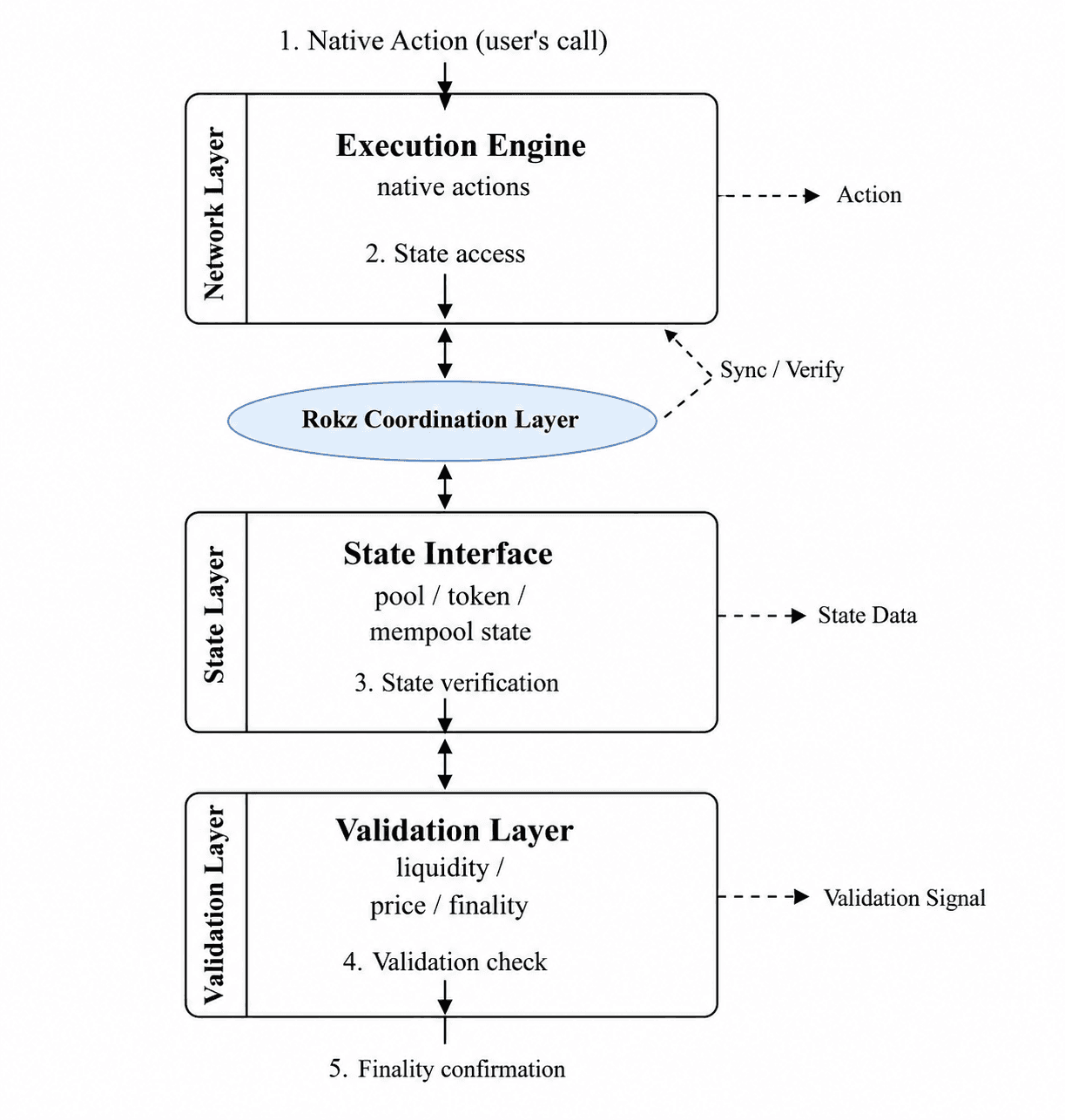
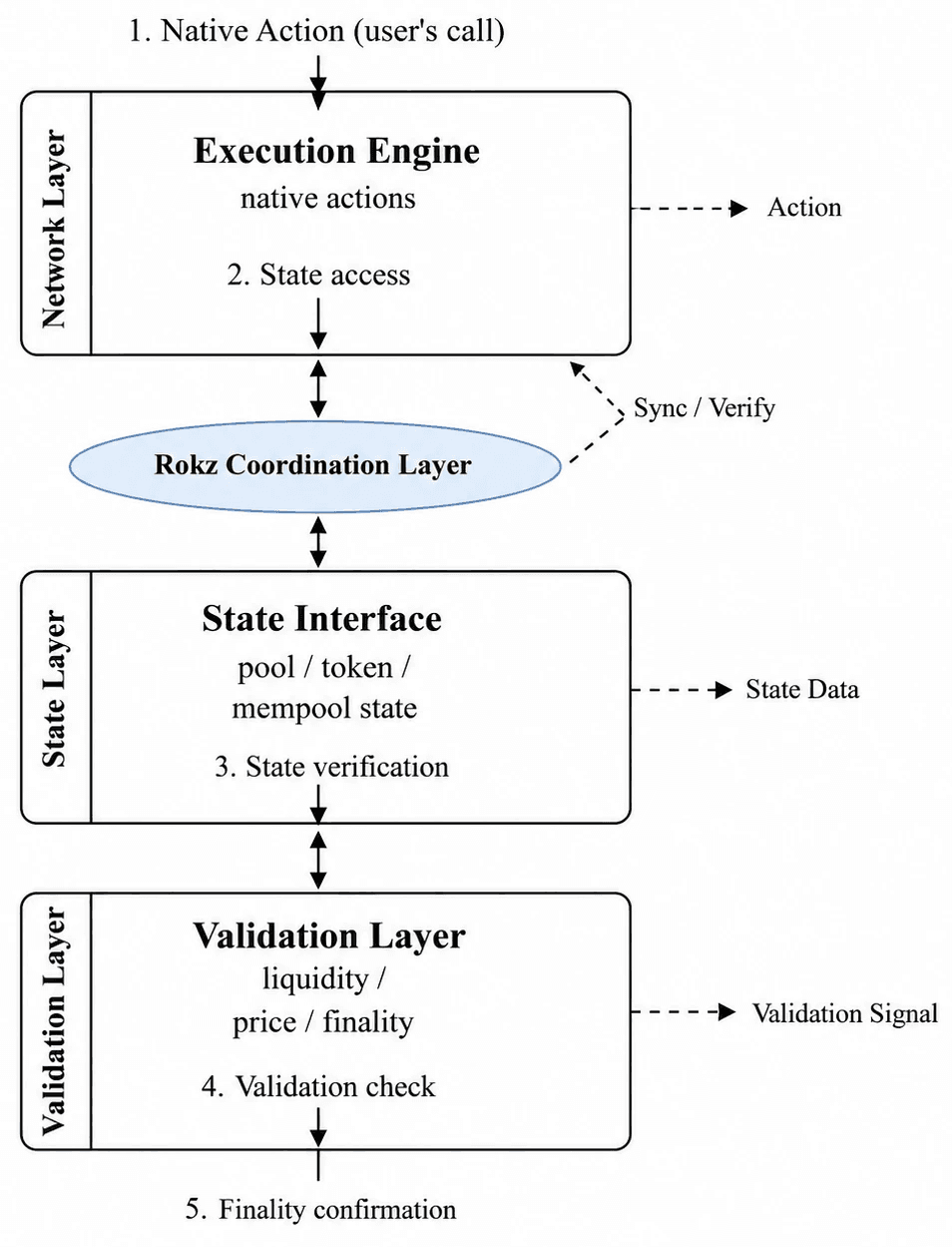
Unified RPC Abstraction
Classical DeFi applications are forced to integrate with many separate RPC environments.
Each blockchain has different:
An application operating across Ethereum, Solana, Base, Arbitrum, Sui, BNB Chain, and other environments must maintain separate connections, separate logic, separate error handling, and separate operational assumptions.
This creates duplication, fragility, cost, and integration complexity.
Rokz Clients abstract RPC access into a unified execution interface. Applications interact with Rokz rather than building and maintaining chain-specific integration stacks.
Internally, Rokz Clients:
The main thesis is clear:
Applications no longer integrate with every chain. They integrate with one execution interface.
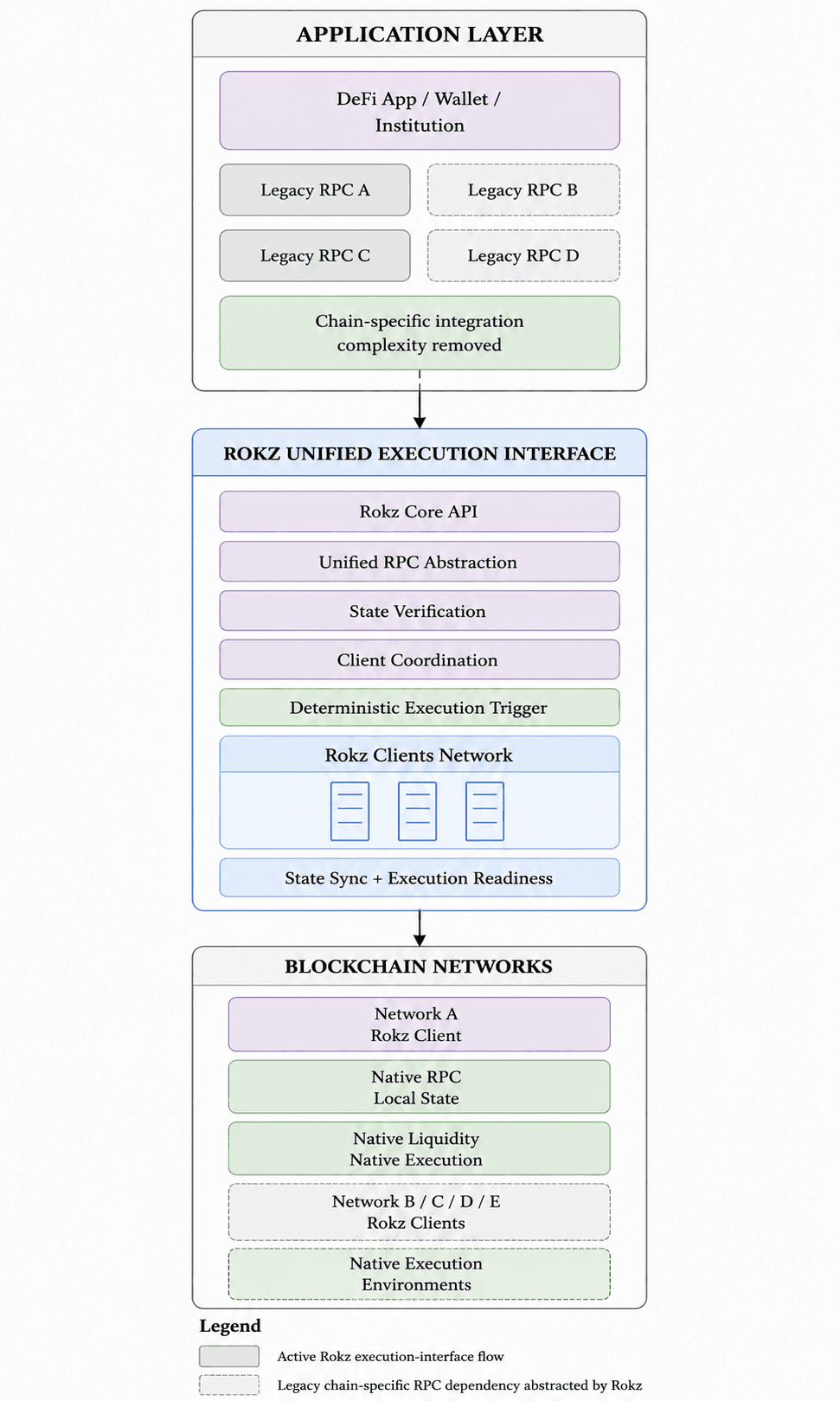
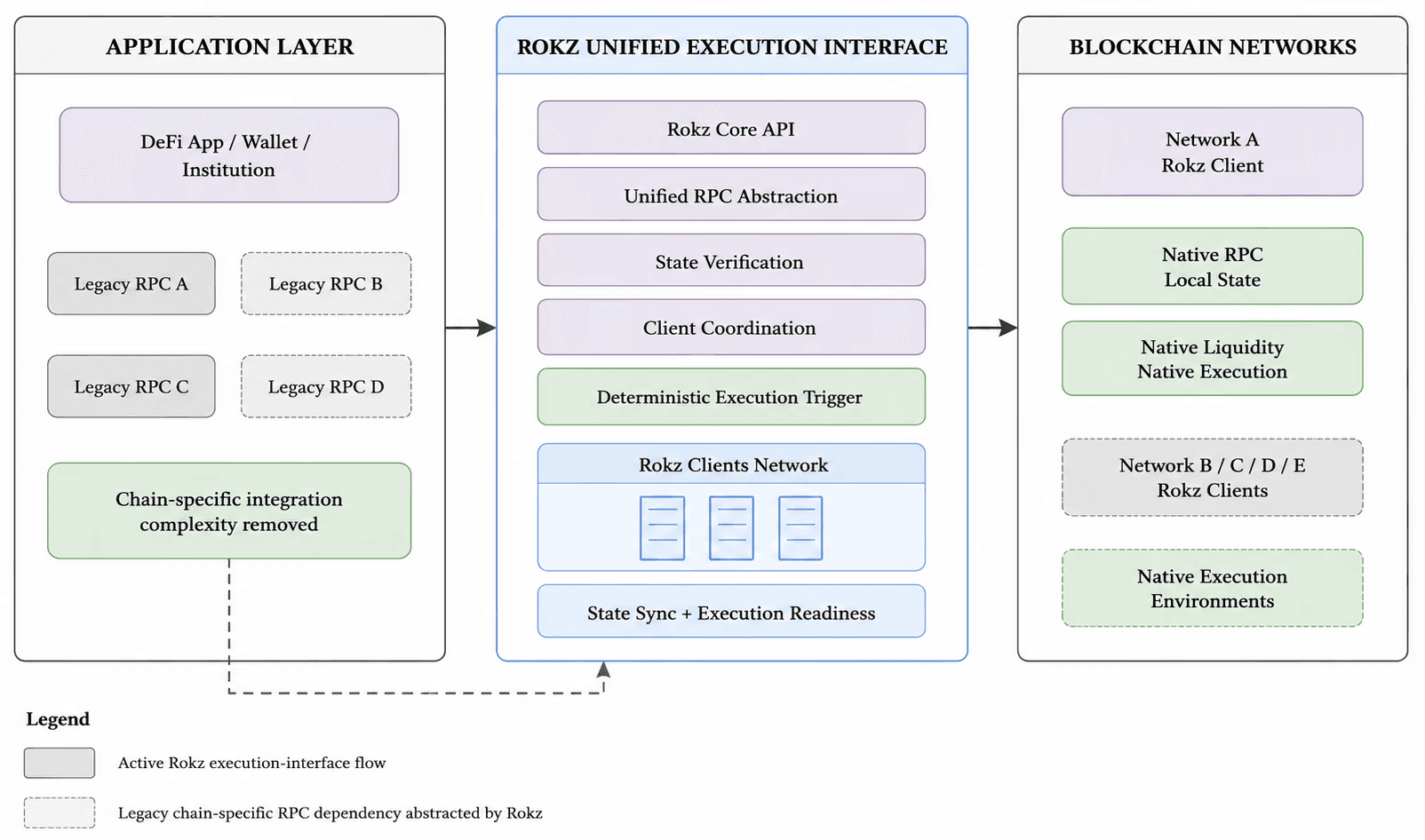
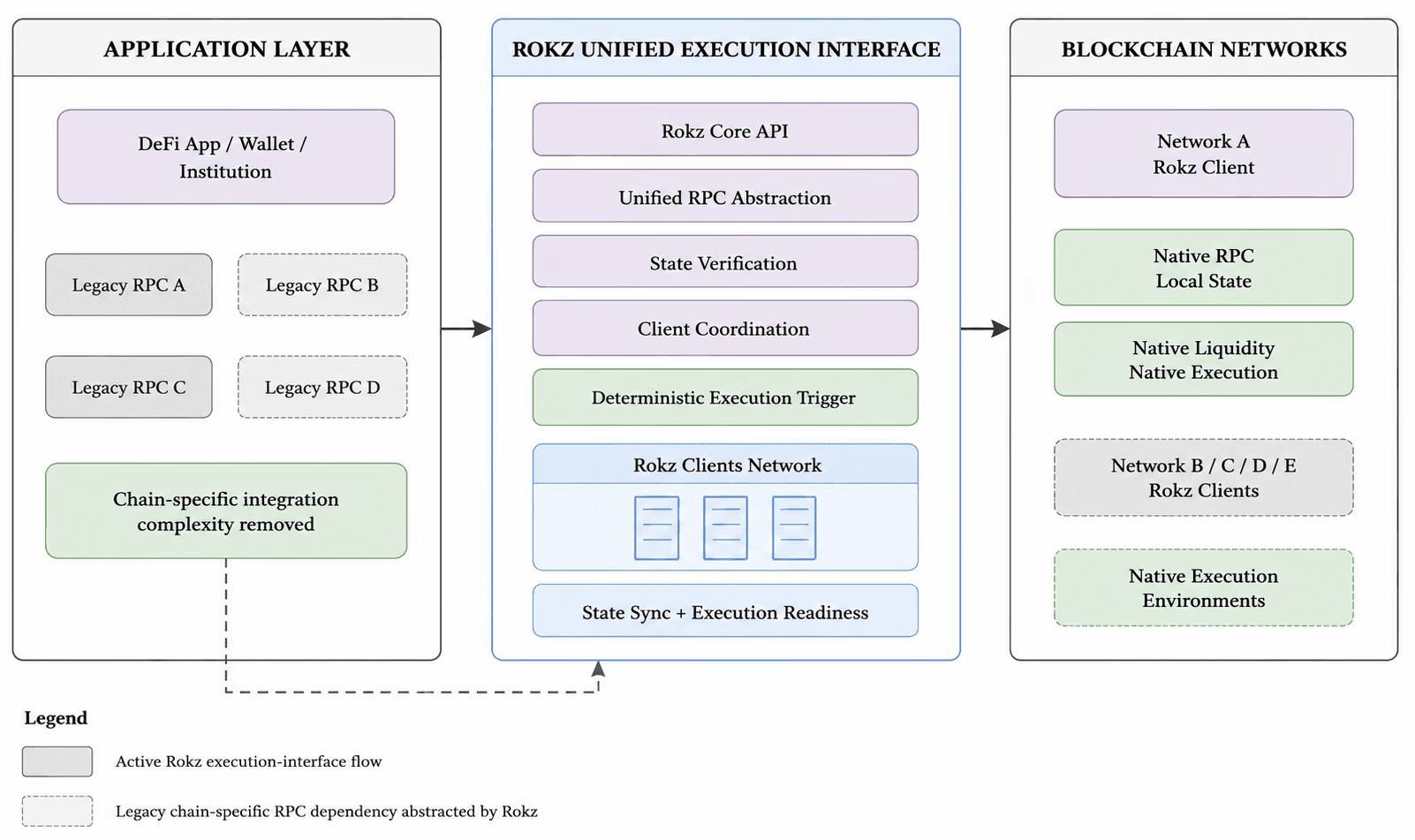
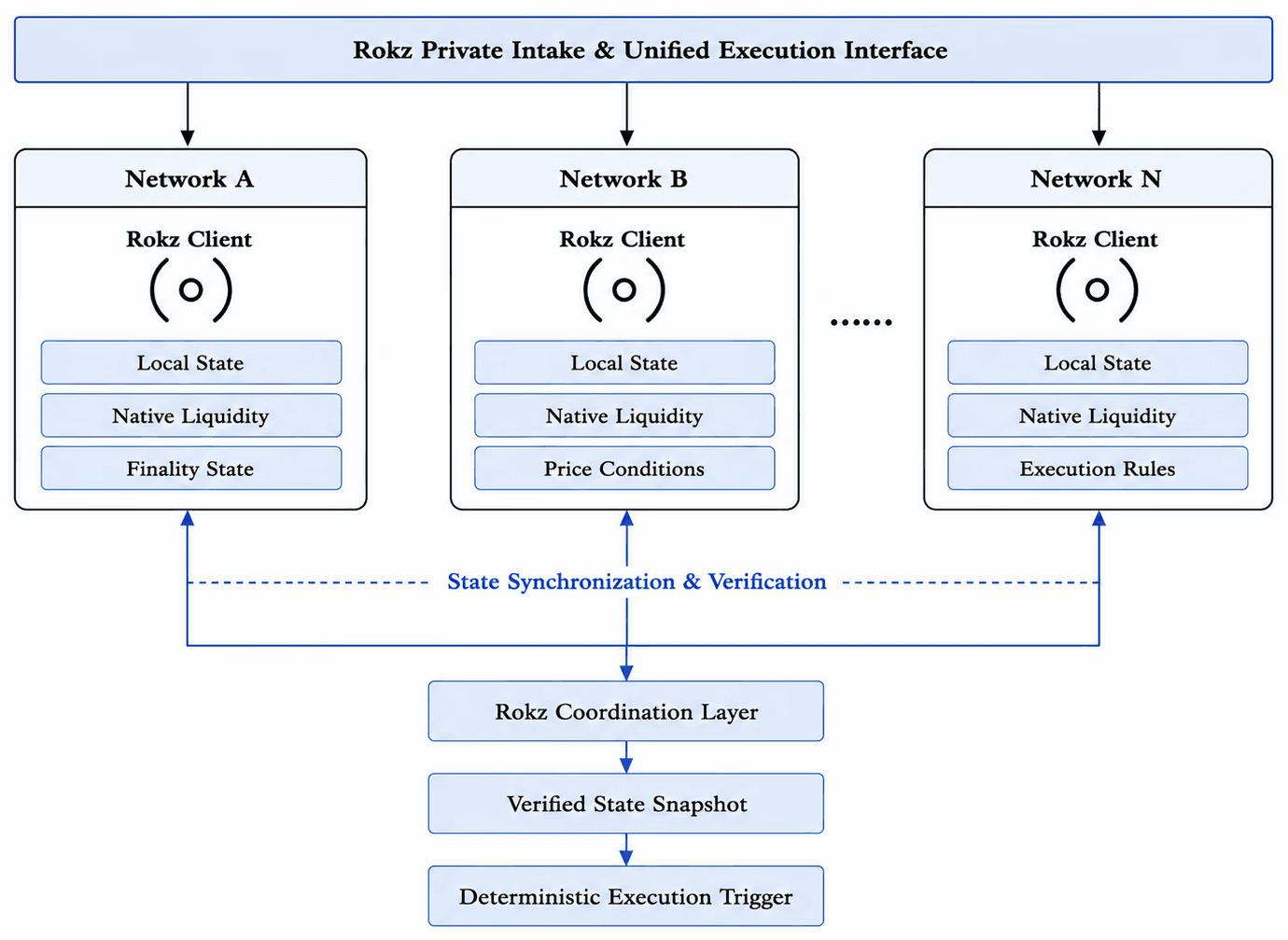
Rokz compresses multi-chain infrastructure into one execution interface, reducing operational overhead for applications, protocols, institutions, and developers.
State Synchronization & Verification
State synchronization and verification are the foundation of deterministic execution.
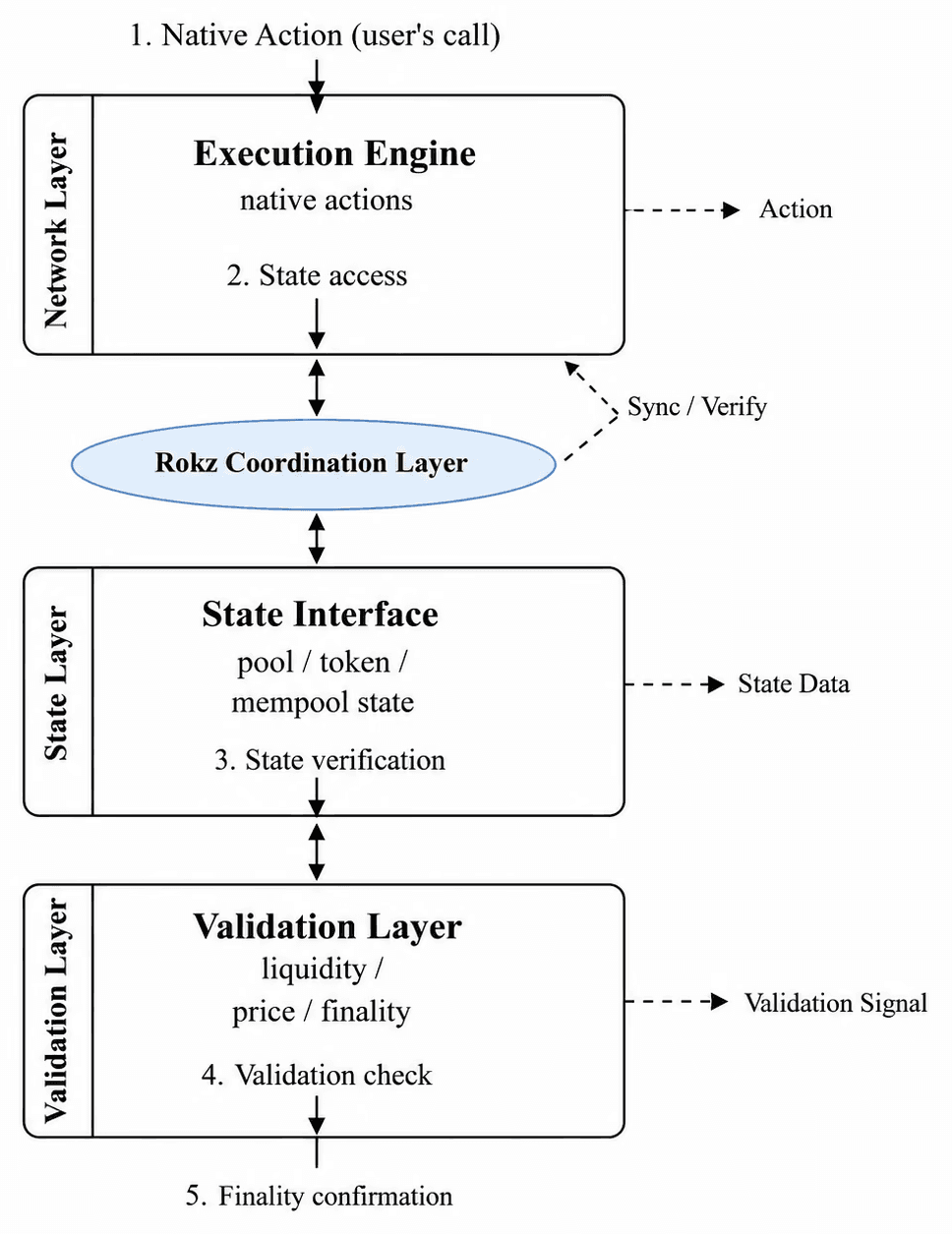
Rokz Clients retrieve real-time state across chains and verify:
Verified states are normalized into a deterministic state snapshot. Execution begins only after state verification is complete. This is how Rokz removes blind transaction submission.
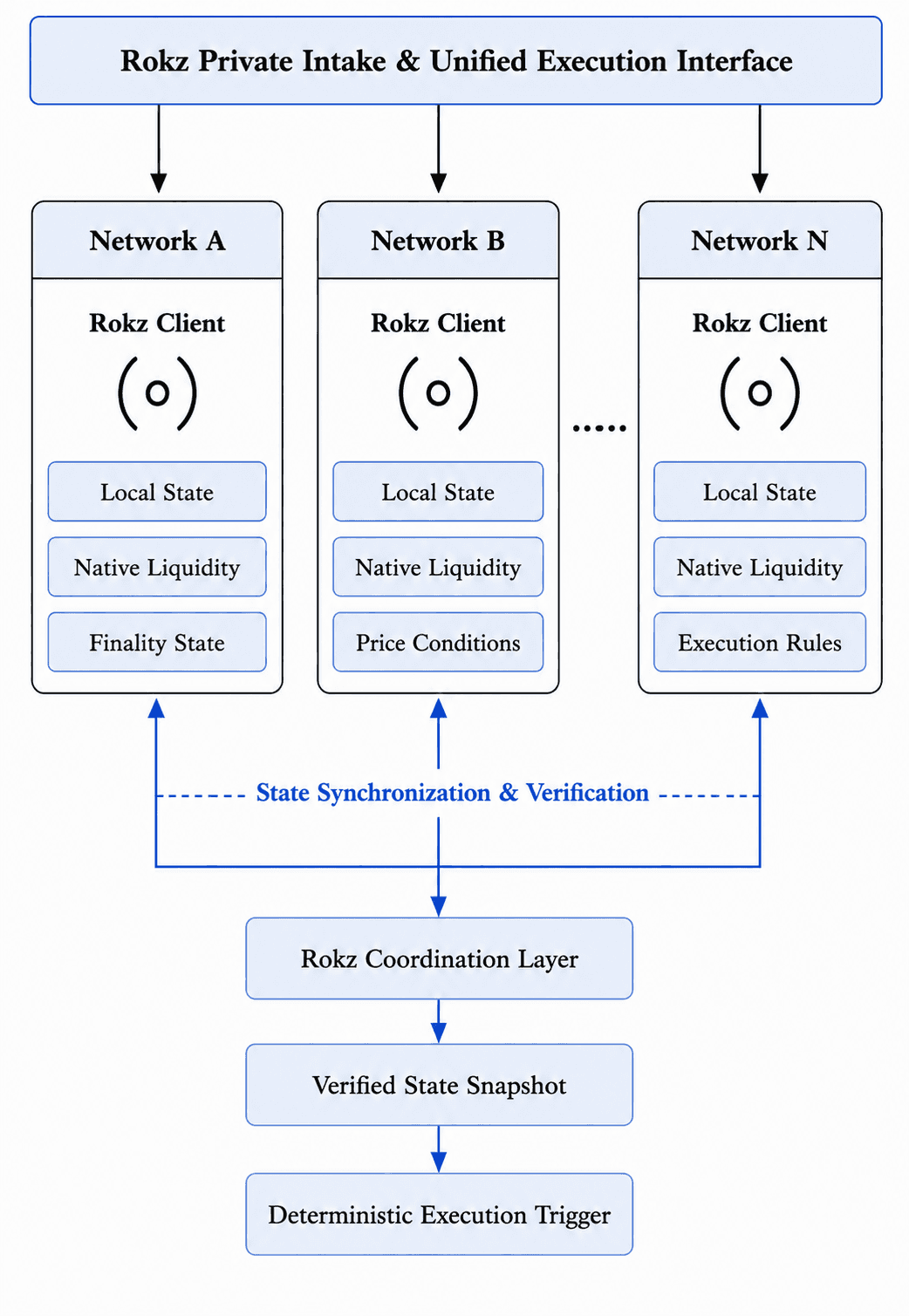
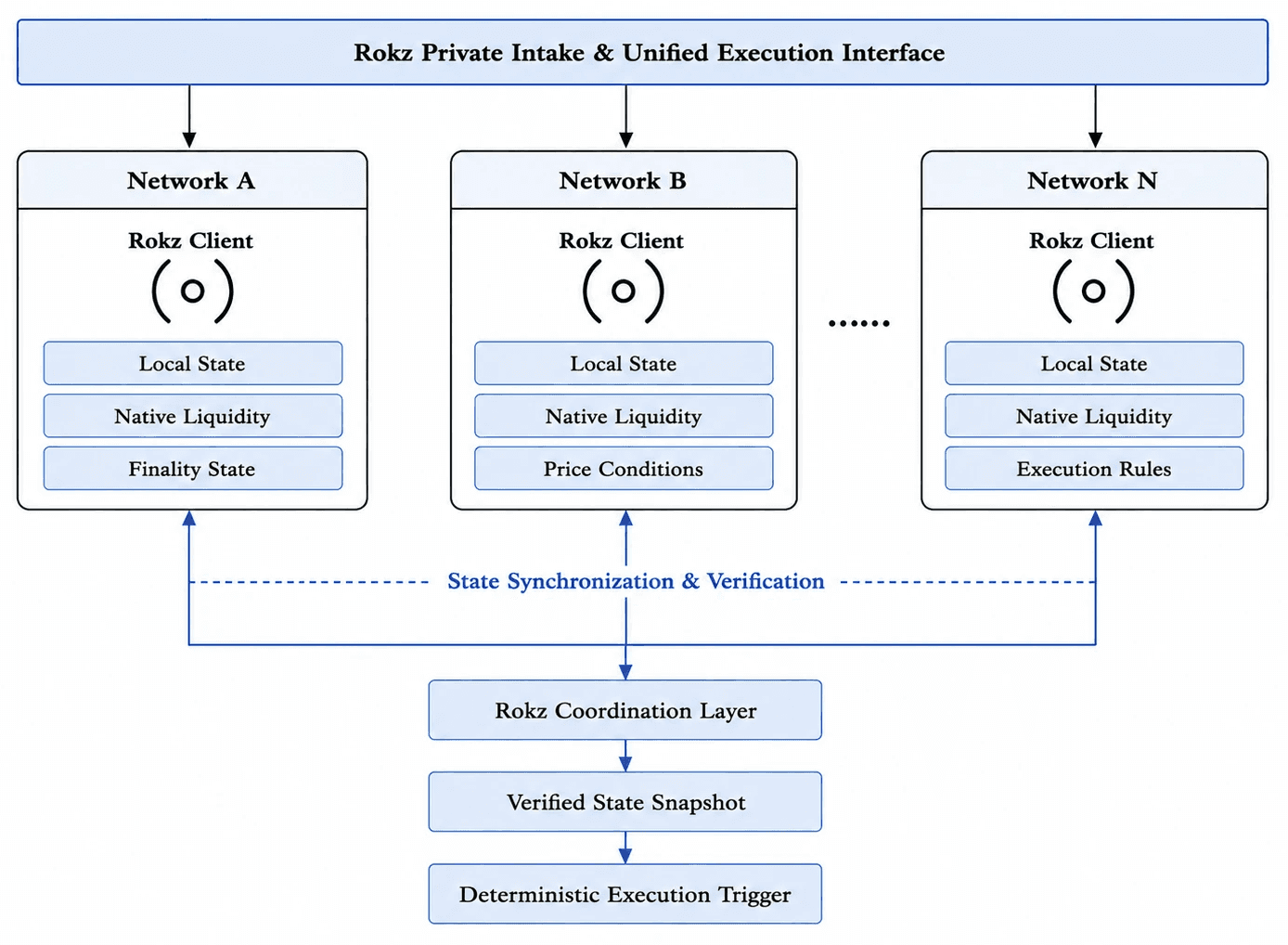
Traditional DeFi systems often execute first and discover failure afterward. A user submits a transaction, the transaction enters a public or semi-public flow, a route is computed, liquidity changes, state drifts, and settlement finalizes probabilistically.
Rokz inverts this sequence.
It verifies state before execution rather than after failure.
State Verification Map
This is the basis for:
When systems execute before state is verified, transaction outcomes depend on changing liquidity, exposed routes, bridge delays, and probabilistic finality. Rokz reverses that sequence.
Rokz removes execution uncertainty by verifying state before execution, not after failure.
Private Execution Infrastructure
Public transaction flow is one of the primary sources of value extraction in DeFi.
When transaction intent enters a public mempool before execution conditions are secured, it becomes visible to adversarial actors. Direction, size, timing, route, and liquidity target can be inferred or directly observed.
That visibility enables:
Rokz Clients preserve private transaction flow before execution.
Transaction details, direction, size, and intent are not publicly visible before settlement. Execution is coordinated through private intake and state verification before native transaction triggering occurs.
This removes the visibility layer required for adversarial sequencing.
Private execution is not a privacy feature added on top of Rokz. It is part of the execution architecture required to reduce MEV exposure before transaction conditions are secured.
MEV is not mitigated at the surface. It is structurally addressed by eliminating public pre-execution exposure.
MPC & Atomic Coordination
Rokz uses MPC as part of its secure coordination architecture.
MPC distributes signing responsibility so that:
MPC also enables secure cross-network operations and atomic settlement coordination.
In a fragmented transaction environment, signing is not merely an authorization step. It is part of settlement integrity. If execution spans multiple environments, the protocol must ensure that signing, transaction triggering, state confirmation, and settlement finality occur under coordinated conditions.
Atomic coordination means:
The objective is to prevent partial failure, incomplete cross-network state, or user exposure to broken settlement.
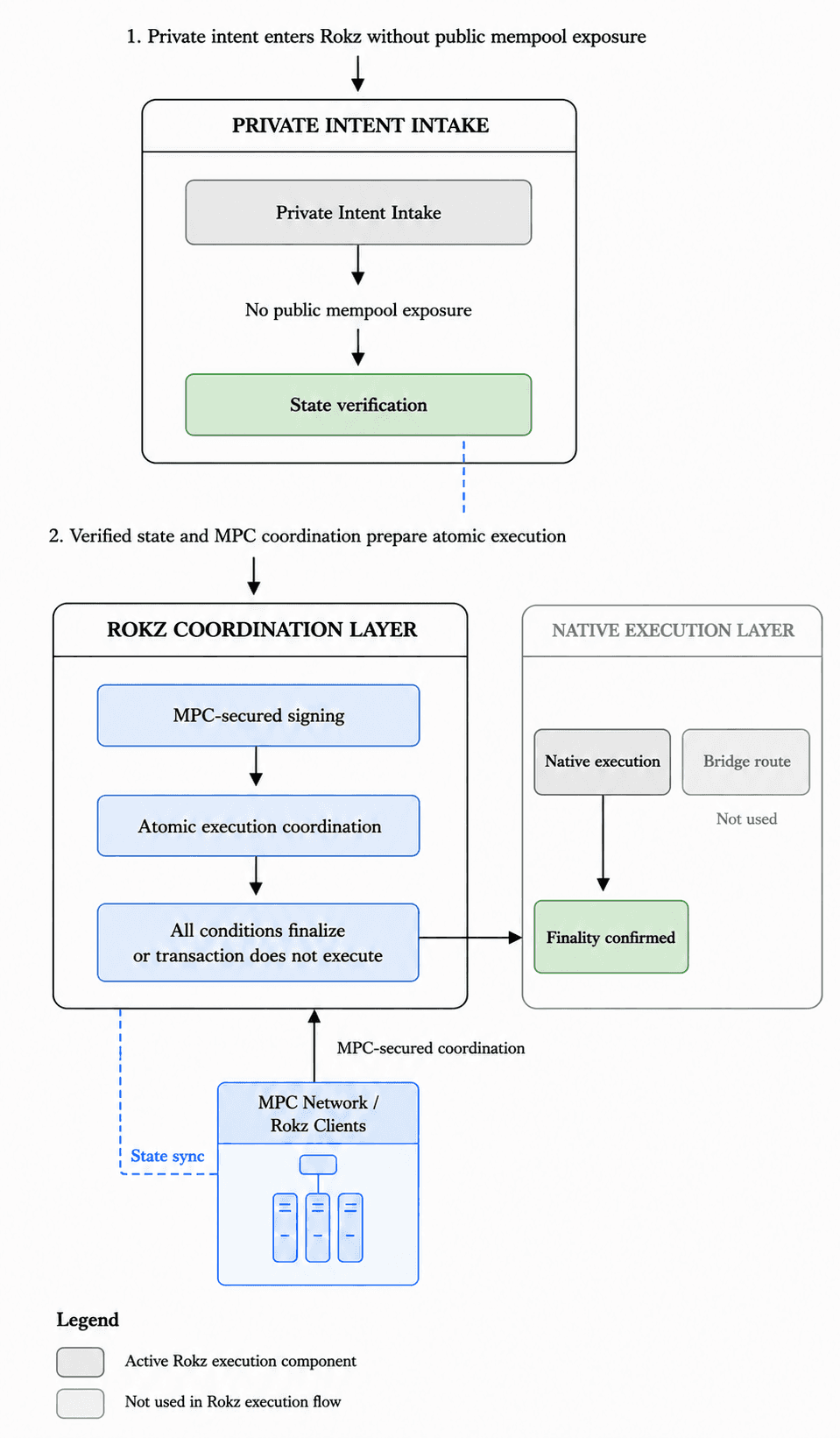
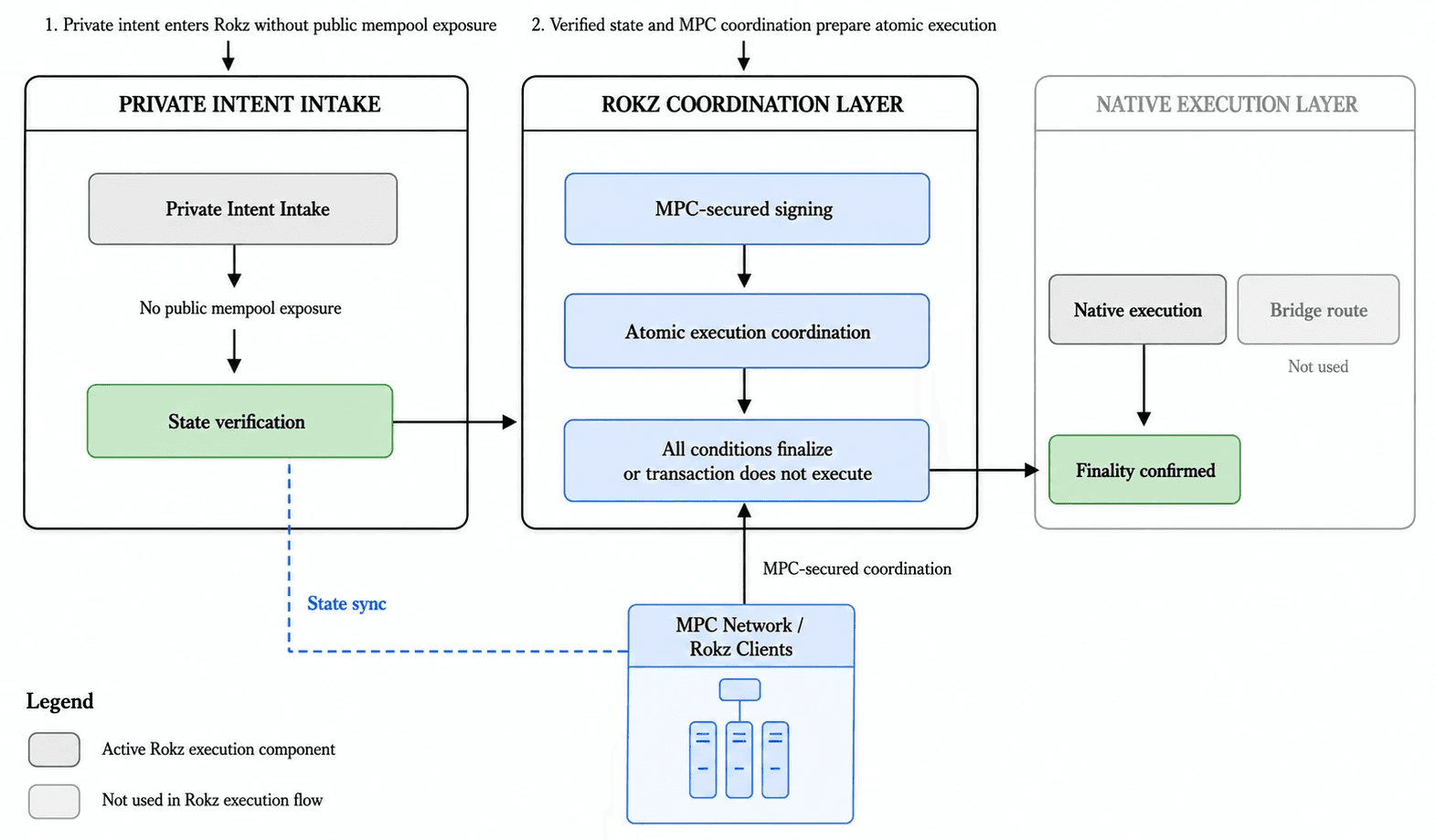
Atomic coordination is not a cosmetic settlement feature. It is the discipline required to prevent users from being exposed to one-sided execution across fragmented networks.
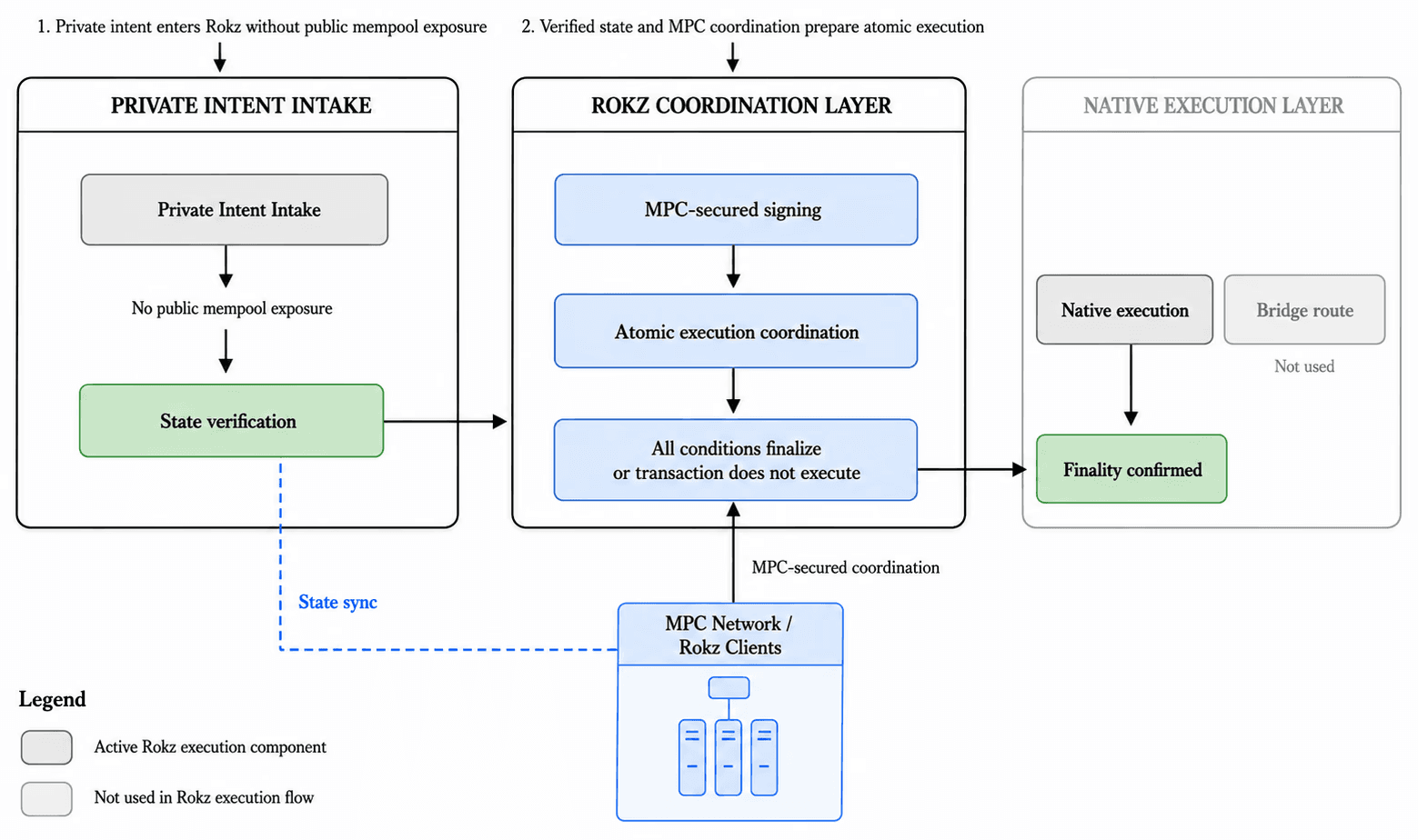
If one side of a cross-network transaction completes while another fails, the user is exposed to broken settlement. Rokz is designed to reduce that risk through MPC-secured coordination and atomic execution logic.
Native Local Execution
Native local execution is one of the most important distinctions in Rokz Protocol.
Liquidity remains in native pools where it already exists.
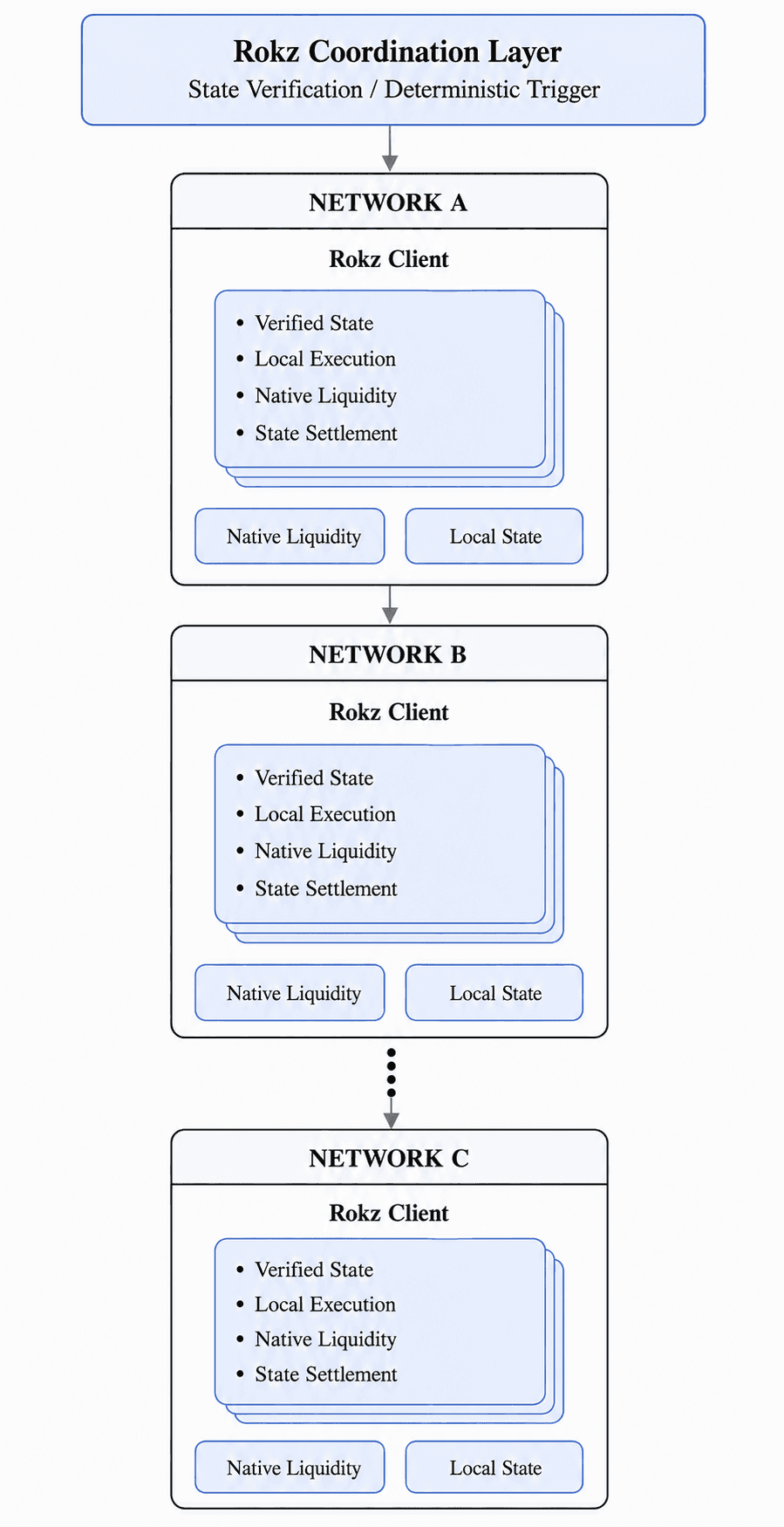
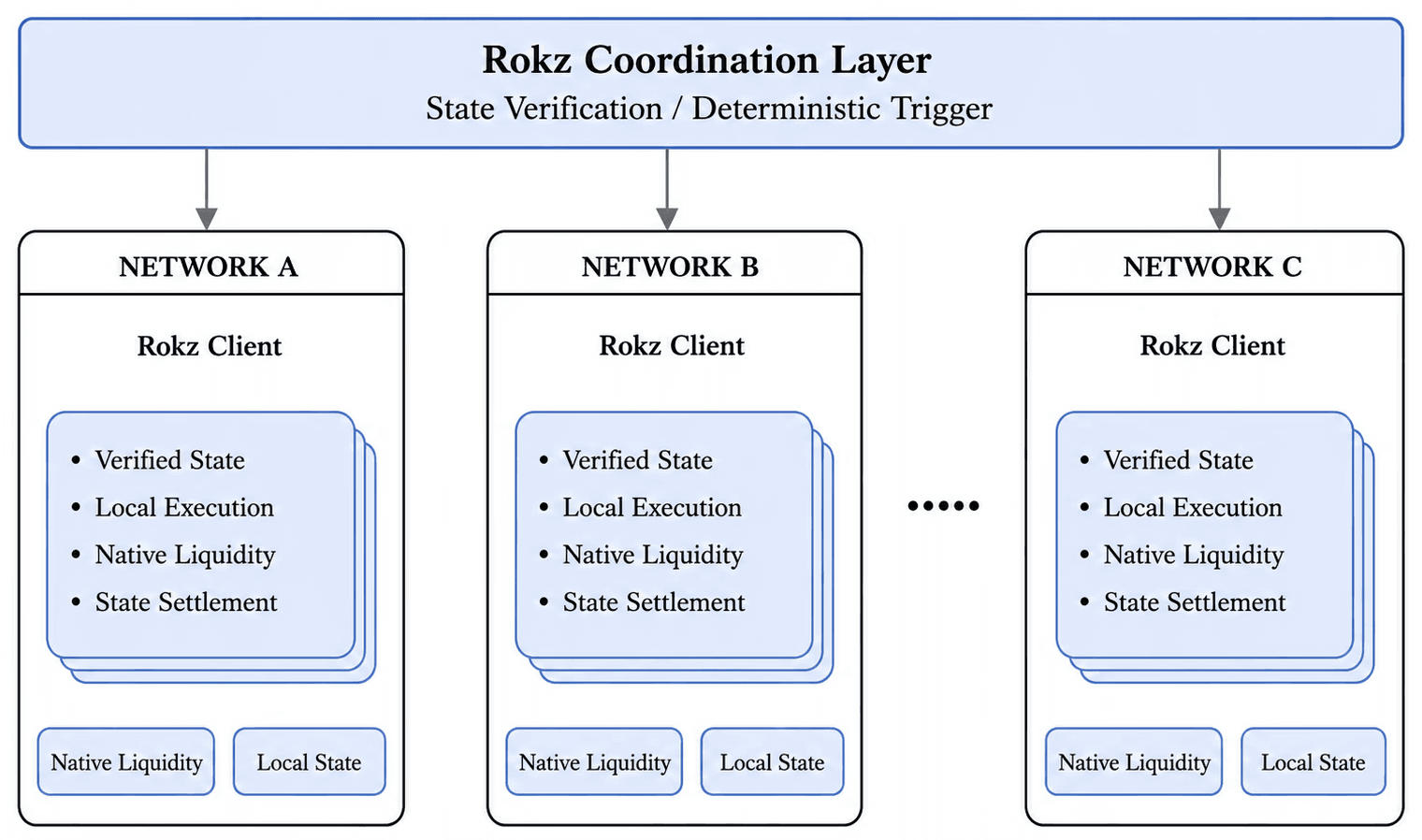
Rokz Clients execute directly inside those environments through local smart-contract calls. If liquidity exists on Ethereum, BNB Chain, Solana, Avalanche, Arbitrum, or another supported network, Rokz coordinates execution inside the relevant native environment rather than transporting liquidity through a bridge or wrapper.
Native Local Execution Thesis
This creates the main operational thesis:
Private execution is not a privacy feature added on top of Rokz. It is part of the execution architecture required to reduce MEV exposure before transaction conditions are secured.