
Whitepaper
v1.4
Whitepaper
v1.4

Rokz Whitepaper
Rokz introduces a unified execution layer for DeFi, eliminating blockchain incompatibility, MEV, and slippage through deterministic, private execution enabled by synchronized state.
Rokz Whitepaper
Rokz introduces a unified execution layer for DeFi, eliminating blockchain incompatibility, MEV, and slippage through deterministic, private execution enabled by synchronized state.

Rokz Protocol Whitepaper
Rokz introduces a unified execution layer for DeFi, eliminating blockchain incompatibility, MEV, and slippage through deterministic, private execution enabled by synchronized state.
Rokz Protocol Whitepaper
Rokz introduces a unified execution layer for DeFi, eliminating blockchain incompatibility, MEV, and slippage through deterministic, private execution enabled by synchronized state.
Rokz Protocol Whitepaper
Rokz introduces a unified execution layer for DeFi, eliminating blockchain incompatibility, MEV, and slippage through deterministic, private execution enabled by synchronized state.
Introduction
Decentralized finance did not solve fragmentation — it optimized around it. Bridges, aggregators, routing layers, and external executors became substitutes for true interoperability, introducing latency, slippage, MEV exposure, intermediary extraction, and execution instability across incompatible blockchains. The industry expanded infrastructure but never rebuilt the coordination layer itself. As a result, DeFi remains structurally fragmented: state is isolated, liquidity is non-native, and deterministic cross-chain execution still does not exist.
Modern DeFi is built on isolated execution environments with fragmented liquidity, separate state, and incompatible processing logic. Bridges, aggregators, and routing layers connect these systems but do not remove fragmentation. Instead, they introduce latency, slippage, MEV exposure, and external dependencies, leaving DeFi structurally reliant on intermediaries rather than native interoperability.
Message passing does not remove fragmented state. Cross-chain routing still introduces slippage, MEV exposure, intermediary dependency, and incompatible finality. Multi-hop execution remains fragmented rather than unified.
Fragmentation cannot be solved by optimizing fragmented infrastructure. Bridges and aggregators add complexity, latency, and dependency. The coordination layer itself must be rebuilt.
Introduction
Decentralized finance did not solve fragmentation — it optimized around it. Routing layers, bridges, aggregators, external executors, and fragmented liquidity environments became substitutes for true interoperability. Every additional hop introduced latency, slippage, MEV exposure, intermediary extraction, and unstable transaction flow across incompatible blockchain systems. The industry expanded infrastructure, but never rebuilt the coordination layer itself. As a result, DeFi remains structurally fragmented: transaction state is isolated, liquidity is non-native, and deterministic processing across chains still does not exist.
Modern DeFi infrastructure was built as a collection of isolated execution environments. Each blockchain maintains separate liquidity, independent state, local mempool exposure, fragmented transaction flow, and incompatible processing logic. Bridges, routing layers, aggregators, and intermediary protocols created connectivity between these systems, but connectivity does not eliminate fragmentation. Every additional layer introduces latency, slippage, MEV exposure, external dependency, and unstable coordination across chains. As a result, DeFi remains structurally dependent on intermediaries rather than native interoperability.
Message passing does not eliminate fragmented state. Routing across chains does not remove slippage, MEV exposure, intermediary dependency, or incompatible finality conditions. A multi-hop path through bridges and external protocols is still not a unified transaction flow.
Fragmentation cannot be solved by optimizing routing through fragmented infrastructure. Bridges, aggregators, and intermediary layers only increase complexity, latency, and external dependency. Fragmentation must be removed at the coordination layer itself.
This is the structural bottleneck Rokz addresses: not connectivity between chains, but deterministic coordination across incompatible blockchain environments without routing dependency, bridge-based transaction flow, intermediary execution, or fragmented liquidity processing.
Rokz addresses the core bottleneck: deterministic coordination across incompatible blockchains without bridges, routing dependency, intermediaries, or fragmented liquidity.
Modern DeFi expanded through chains, bridges, routers, and aggregators, increasing fragmentation, routing complexity, slippage, MEV exposure, and intermediary dependency. Rokz addresses these constraints through Rokz Clients—a verification and synchronization layer that establishes shared state before execution.
Seamless Execution Shift
DeFi expanded through bridges, routers, and aggregators, but each layer increased complexity, slippage, MEV exposure, and dependency on intermediaries. Connectivity improved, yet deterministic cross-chain execution never emerged.
Beyond Intermediaries
DeFi assumed fragmentation could scale through more liquidity venues and interoperability through bridges, aggregators, routers, and solvers. In practice, each layer increased fragmentation, intermediary dependency, slippage, MEV exposure, and coordination complexity. Connectivity expanded, but unified deterministic cross-chain execution never emerged.
Core Execution Principles
As Rokz introduces a new execution paradigm, it is essential to define the principles that guide its design and operation:
Seamless Execution Shift
DeFi expanded through bridges, routers, aggregators, and solver networks, but every additional layer increased routing complexity, slippage, MEV exposure, intermediary dependency, and fragmented coordination between chains. Connectivity improved, yet deterministic transaction flow across blockchain environments never emerged.
Rokz Beyond Intermediaries
The historical architecture of DeFi assumed fragmented liquidity could scale through more venues, while interoperability could be achieved through bridges, aggregators, relayers, routers, and solver networks. In practice, every additional layer increased transaction fragmentation, intermediary dependency, slippage exposure, MEV extraction, routing complexity, and incompatible coordination between chains. The industry expanded connectivity and transaction surface area, but never created unified deterministic transaction flow across blockchain environments.
Modern DeFi expanded through fragmented chains, bridges, routers, and aggregators, but each additional layer increased liquidity fragmentation, routing complexity, slippage, MEV exposure, intermediary dependency, and state inconsistency across blockchain environments. Rokz addresses these structural interoperability constraints through Rokz Clients — a verification and synchronization layer that establishes shared blockchain state prior to transaction processing.
Core Execution Principles
As Rokz introduces a new execution paradigm, it is essential to define the principles that guide its design and operation:
Native Interoperability: Rokz Clients synchronize and verify blockchain state across incompatible environments before transaction coordination.
Native Interoperability:
Native Interoperability: Rokz Clients synchronize and verify blockchain state across incompatible environments before transaction coordination.
Native Interoperability:
MEV Neutralized: Private transaction flow through Rokz Mempool before public exposure. No visible order flow. No extraction layer.
MEV Neutralized:
MEV Neutralized: Private transaction flow through Rokz Mempool before public exposure. No visible order flow. No extraction layer.
MEV Neutralized:
MEV Neutralized: Private transaction flow through Rokz Mempool before public exposure. No visible order flow. No extraction layer.
MEV Neutralized:
Near-Zero Slippage: Liquidity and state conditions are verified before processing begins. Transactions finalize only under stable conditions via Rokz Clients in Local Liquidity Pools.
Near-Zero Slippage:
No Routed Fragmentation: No multi-hop routing. No bridge chains. No fragmented transaction paths between networks.
No Routed Fragmentation:
MEV Neutralized: No aggregators. No solvers. No external executors. Transaction coordination happens directly through Rokz Clients.
No Intermediary Dependency:
Near-Zero Slippage: Liquidity and state conditions are verified before processing begins. Transactions finalize only under stable conditions via Rokz Clients in Local Liquidity Pools.
Near-Zero Slippage:
No Routed Fragmentation: No multi-hop routing. No bridge chains. No fragmented transaction paths between networks.
No Routed Fragmentation:
No Routed Fragmentation: No multi-hop routing. No bridge chains. No fragmented transaction paths between networks.
No Routed Fragmentation:
No Intermediary Dependency: No aggregators. No solvers. No external executors. Transaction coordination happens directly through Rokz Clients.
No Intermediary Dependency:
No Intermediary Dependency: No aggregators. No solvers. No external executors. Transaction coordination happens directly through Rokz Clients.
No Intermediary Dependency:
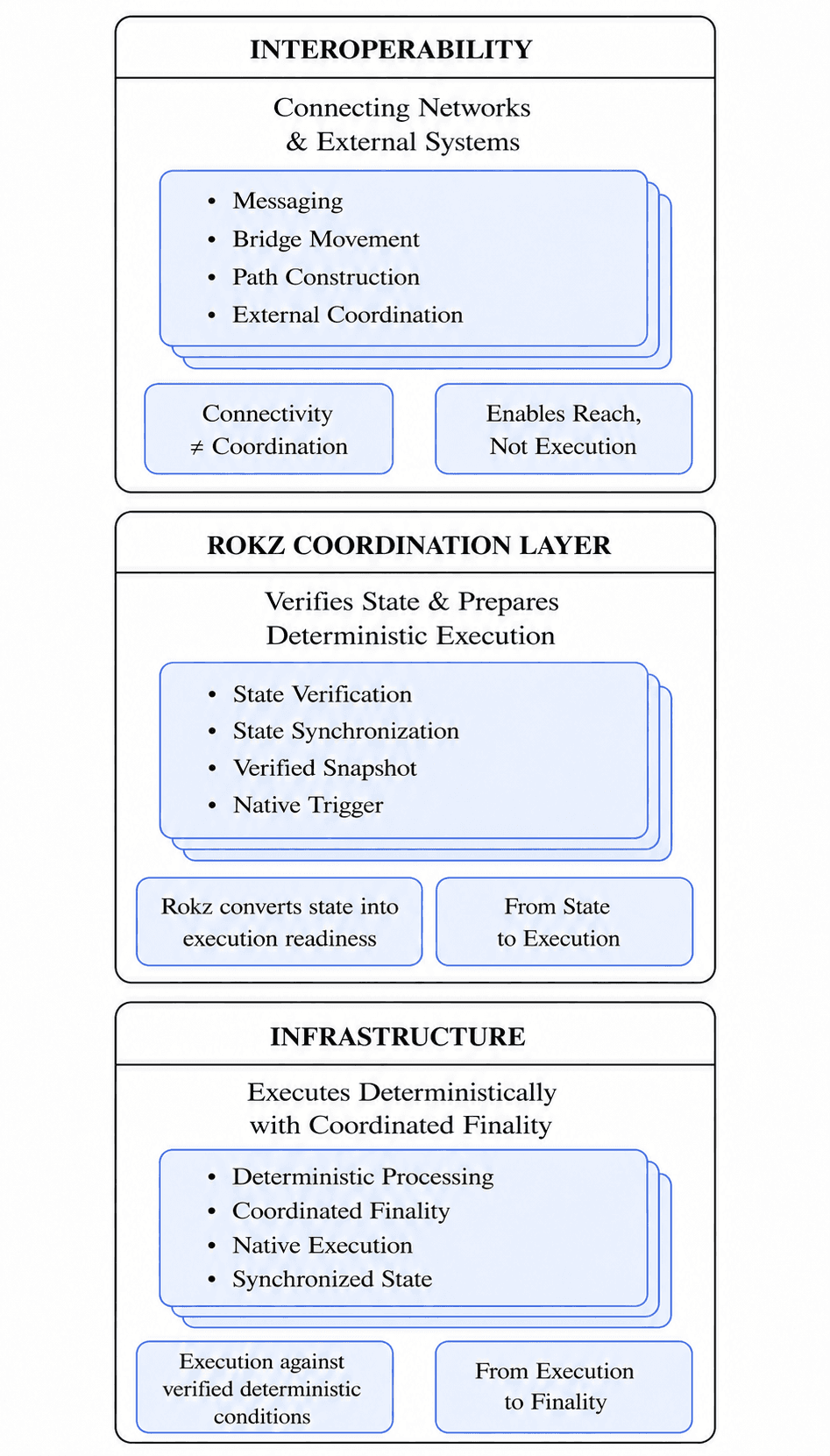
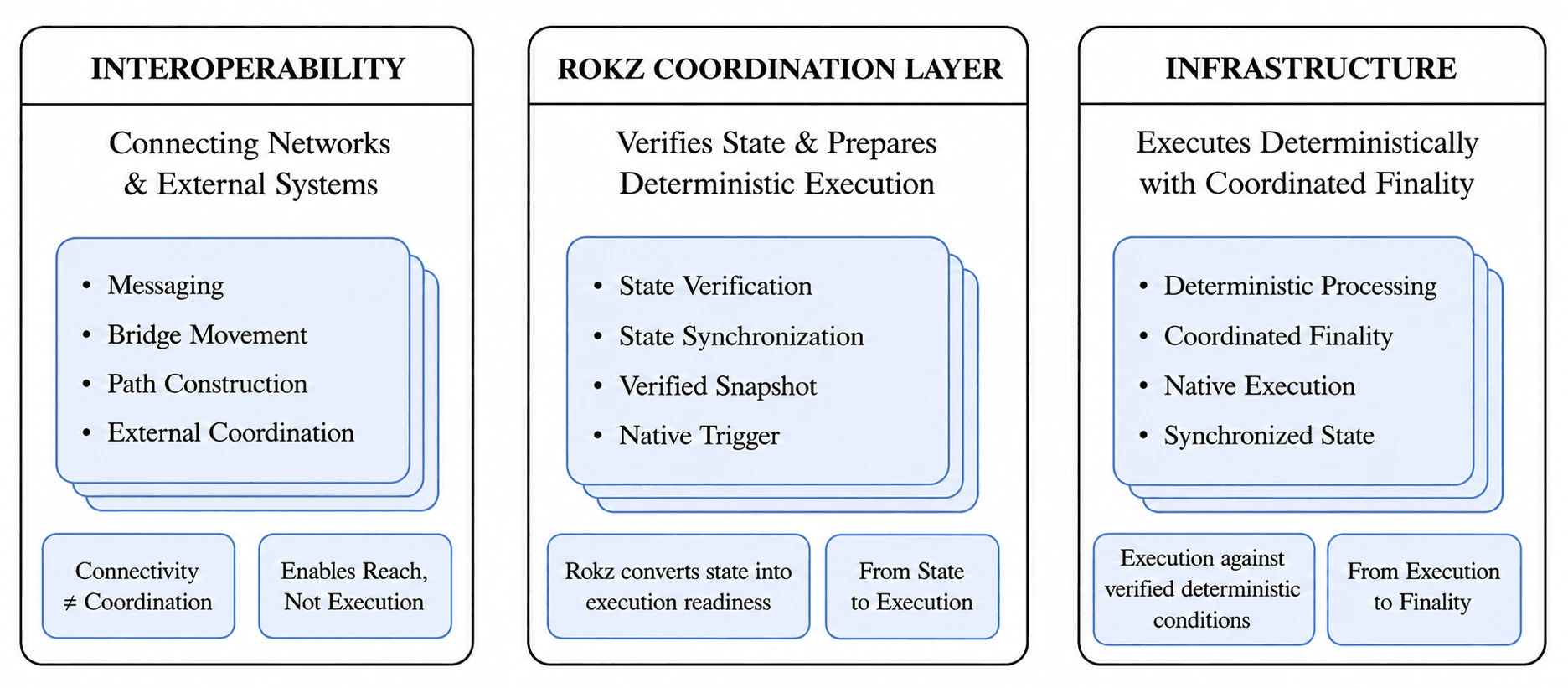
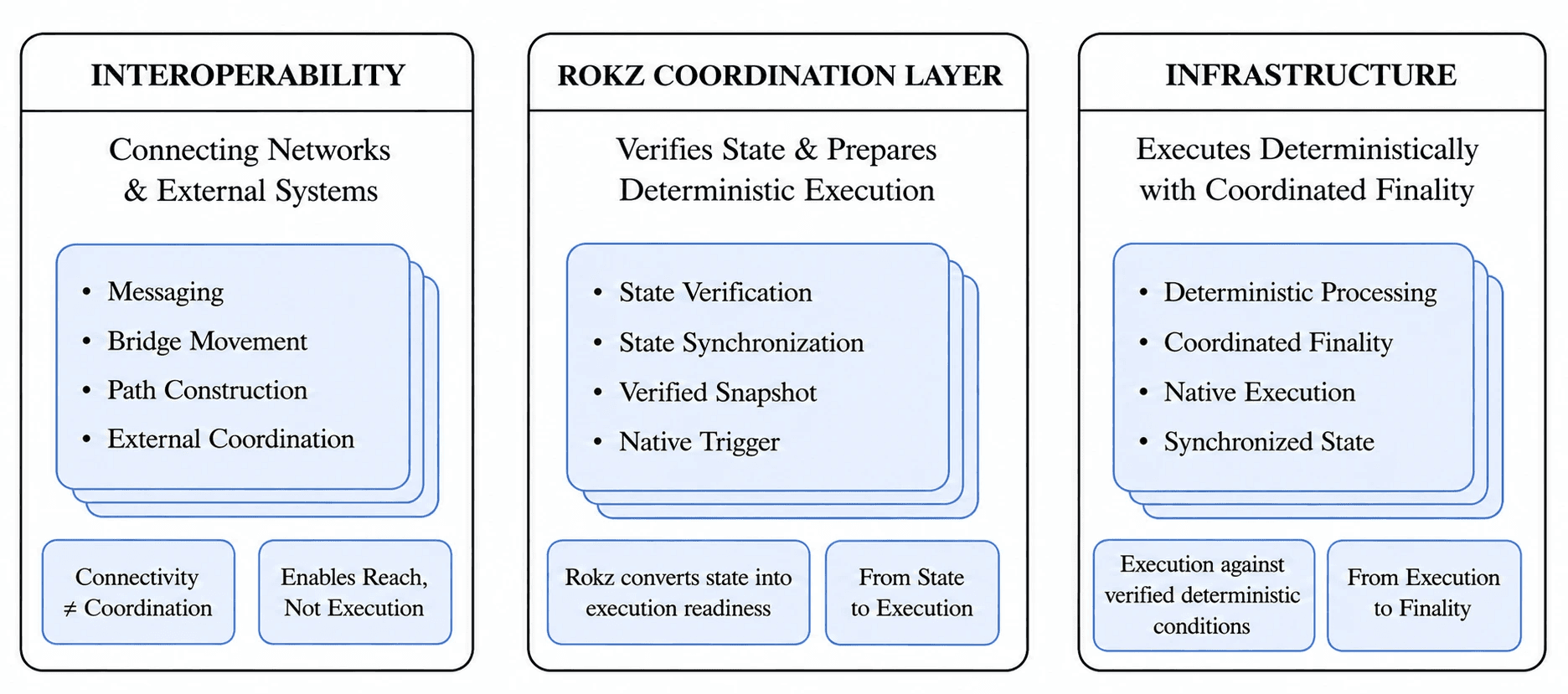
This is the distinction between connectivity and coordination. Bridges, routers, aggregators, and interoperability protocols can route liquidity across fragmented systems, but they cannot eliminate slippage, MEV exposure, intermediary dependency, or incompatible transaction conditions between chains. True infrastructure requires deterministic transaction coordination through verified state synchronization across blockchain environments.
Connectivity moves liquidity; coordination enables execution. Bridges and aggregators cannot eliminate slippage, MEV exposure, intermediary dependency, or incompatible conditions. True interoperability requires deterministic coordination through verified state synchronization.
Interoperability Rebuilt
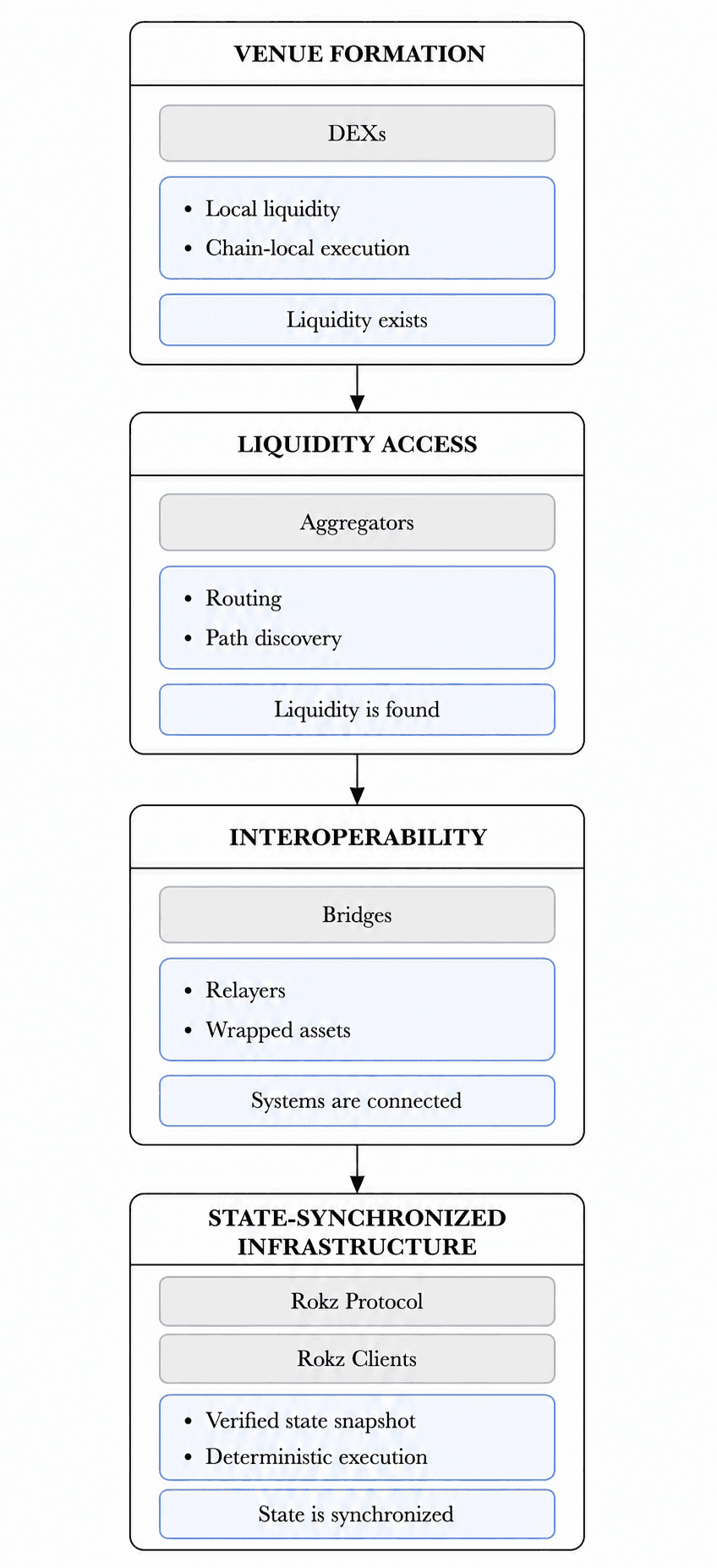
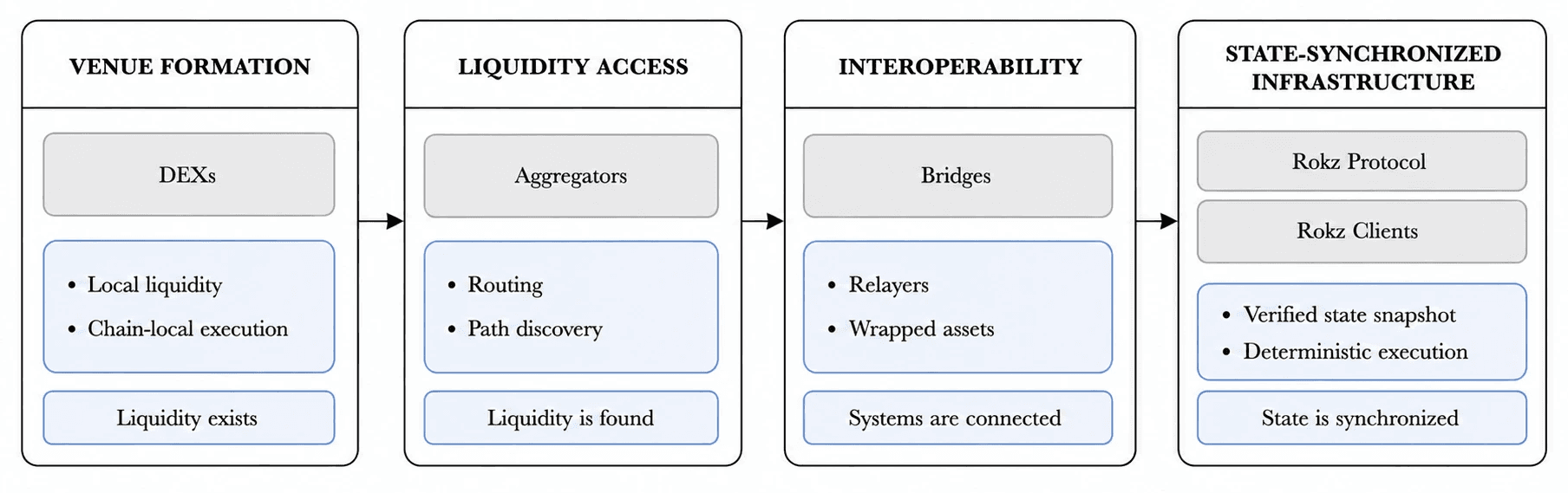
DeFi infrastructure evolved through bridges, aggregators, wrapped assets, relayers, solvers, and multi-chain routing, but these systems only expanded fragmented coordination across incompatible blockchain environments. They could move messages, route liquidity, and transfer asset representations, yet they never established deterministic transaction coordination between chains. Rokz introduces a different primitive: verified state synchronization through Rokz Clients. By retrieving, validating, synchronizing, and coordinating blockchain state before transaction processing begins, Rokz replaces fragmented path construction with deterministic coordination across heterogeneous environments.
Interoperability Rebuilt
DeFi evolved through bridges, aggregators, and routing layers, but these systems expanded fragmentation rather than solving it.
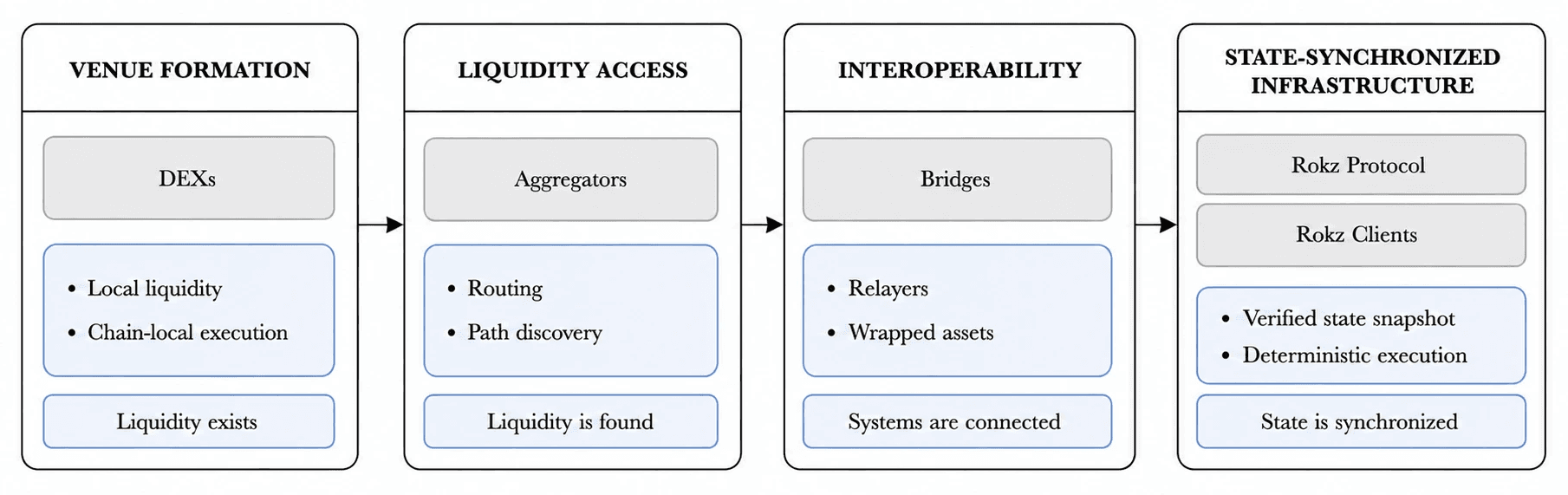
Rokz introduces a different primitive: verified state synchronization through Rokz Clients. By retrieving, validating, synchronizing, and coordinating blockchain state before transaction processing begins, Rokz replaces fragmented path construction with deterministic coordination across heterogeneous environments.
Whitepaper Overview
As decentralized finance continues to evolve, the need for a unified execution layer becomes increasingly critical. Rokz introduces a foundational shift in how systems interact, removing fragmentation and redefining execution at scale. Whether you are building, integrating, or participating in decentralized ecosystems, Rokz provides the infrastructure to enable deterministic, efficient, and secure execution across all chains. Join us in shaping the next evolution of DeFi.
Whitepaper Overview
As DeFi evolves, a unified execution layer becomes essential. Rokz removes fragmentation and enables deterministic, efficient, and secure execution across all chains, redefining how decentralized systems operate at scale.
This whitepaper presents the architecture and execution model of the Rokz Protocol as a unified execution layer, reflecting its current design and direction while remaining subject to ongoing refinement rather than a final specification.
This whitepaper outlines the current architecture and execution model of Rokz as a unified execution layer and remains subject to ongoing refinement.