
Rokz is that architectural transition.
From Routing to State-Verified Execution
The conventional model begins with a transaction and searches for a path. Rokz begins with state and determines whether deterministic processing is possible.
This inversion is the core paradigm shift.
Conventional Model
The conventional model follows a path-dependent sequence:
The conventional model follows a path-dependent sequence:
Rokz Model
The Rokz model follows a state-conditioned sequence:
This model is structurally different because it does not rely on pathfinding through fragmented infrastructure. It coordinates native processing through a verified state basis.
Deterministic Execution
Deterministic execution in Rokz refers to transaction processing whose outcome is defined by verified state before submission into native environments.
More precisely, a Rokz-coordinated transaction can be represented as:
O = F(X, S, C)
Where:
A transaction is eligible for processing only if [ S ] satisfies the preconditions required by [ F ]. If state changes before the transaction can be safely processed, the transaction is not forced through a stale path. It is re-verified, re-synchronized, or rejected according to protocol rules.
This is the infrastructure difference between deterministic processing and route-based approximation.
Deterministic Processing Requirements
Rokz deterministic processing requires four conditions:
When these conditions are satisfied, transaction coordination no longer depends on blind submission into fragmented systems. It becomes a controlled deterministic process.
State-Verified Coordination
State verification is the central security and coordination primitive of Rokz Protocol.
Rokz Clients retrieve state from relevant environments, validate that state against protocol-defined criteria, normalize incompatible state formats, and merge verified observations into a unified deterministic snapshot. The pitchdeck describes this as state retrieval, state validation, cross-chain state verification, and aggregation into a unified deterministic snapshot.
Rokz Clients
Rokz Clients are the synchronization architecture of the protocol. They operate as the interface between heterogeneous chain environments and the Rokz coordination layer.
Their role is not to replace native chain consensus. Their role is to remove intermediary coordination at the protocol-logic level by creating a verified state substrate for deterministic transaction processing.
Rokz Clients perform six core functions:
This architecture is what allows Rokz to abstract incompatible chains without relying on bridges, route construction, or solver markets as the central mechanism.
Unified Deterministic State Snapshot
The unified deterministic state snapshot is the coordination object that replaces route-based approximation.
It is not a global blockchain. It is not a synthetic liquidity pool. It is not a bridge ledger. It is a verified state representation constructed from chain-local observations and validated through Rokz Clients.
The snapshot answers the question that current infrastructure often leaves unresolved:
“Can this transaction be processed across relevant environments under deterministic conditions?”
If the answer is yes, the protocol triggers native local processing. If the answer is no, the transaction is not forced into a probabilistic path.
Private Transaction Flow
Private transaction flow is not an optional privacy feature. It is a requirement for deterministic coordination.
When transaction intent is exposed before verification and processing, the transaction becomes part of an adversarial information market. Public exposure enables ordering attacks, state manipulation, liquidity withdrawal, and route interference. This is especially damaging in multi-domain environments, where latency and finality asymmetry widen the extraction window.
Rokz introduces private intake through Rokz Clients. The deck describes Rokz Clients as replacing validators and intermediaries with a private mempool at the coordination layer, enabling pre-verified state and deterministic native liquidity processing without bridges, routing, or VM constraints.
Institutionally, the important point is not merely that transaction flow is hidden. The point is that transaction flow is withheld from adversarial ordering surfaces until the protocol has verified state and defined deterministic processing conditions.
Private flow therefore supports three infrastructure objectives:
Privacy and determinism are mutually reinforcing. Private flow protects the transaction from adversarial state changes. State verification protects the transaction from blind execution.
Native Local Execution
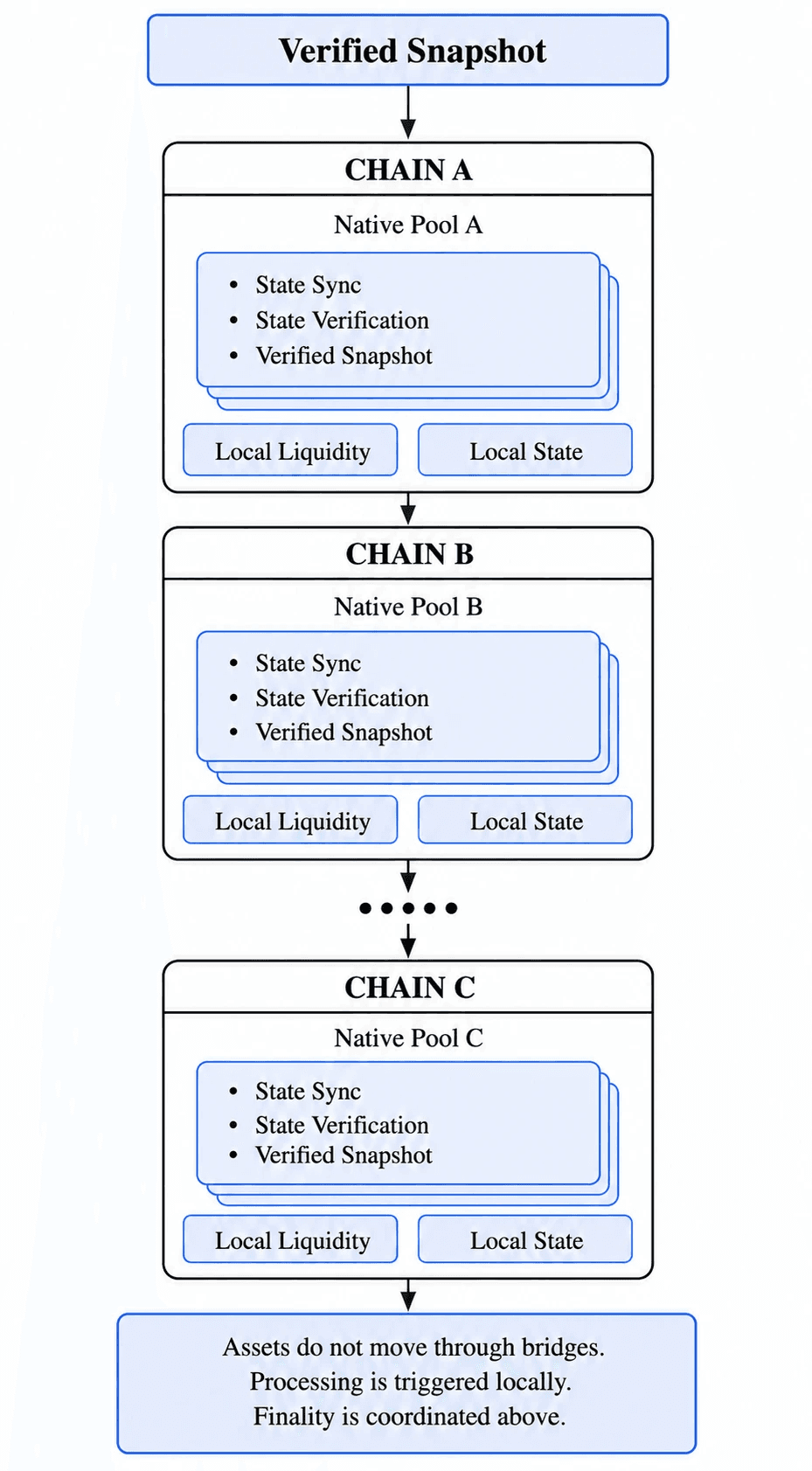
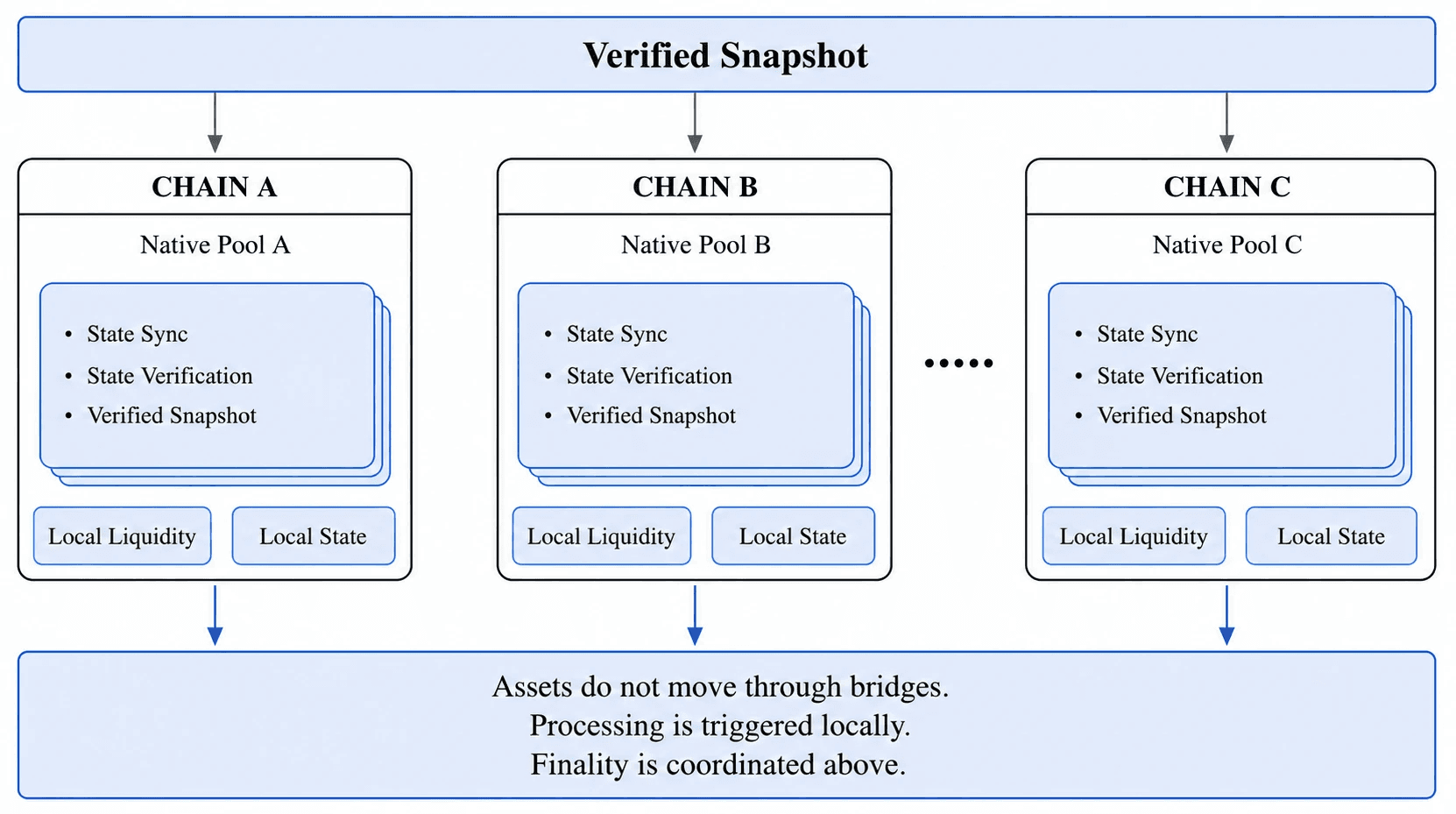
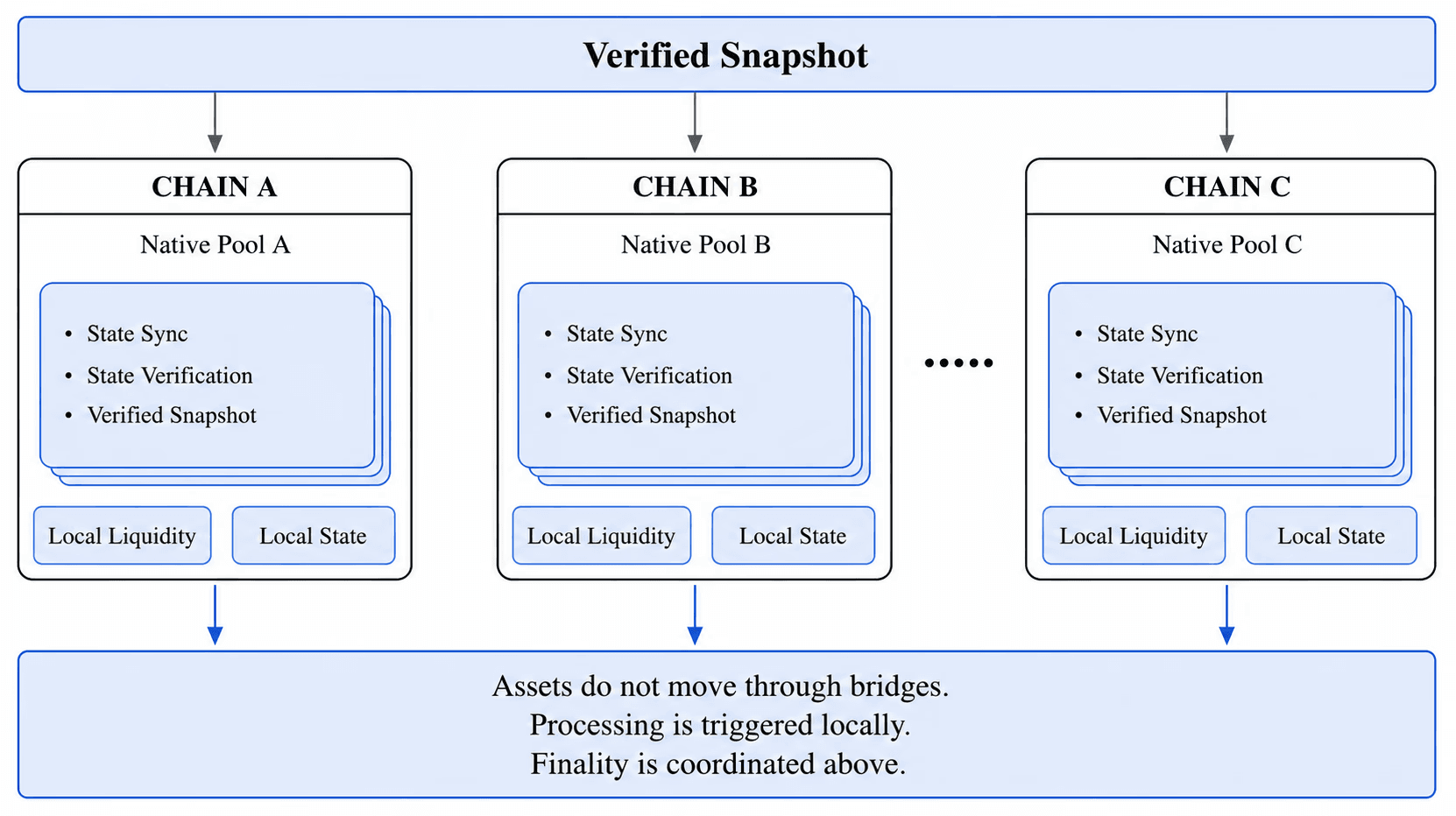
Rokz does not require liquidity to be bridged, wrapped, migrated, or centralized into a new venue. It coordinates native local liquidity.
This is one of the most important distinctions in the protocol architecture. Native local processing means that liquidity remains inside the environments where it already exists, governed by native contracts and native finality. Rokz abstracts coordination above those environments rather than forcing liquidity into a synthetic global route.
Pre-verified state enables deterministic execution in native liquidity with no bridges, no routing, and no VM constraints.
Rokz Clients perform six core functions:
Bridged liquidity introduces representation risk. Routed liquidity introduces path dependency. Synthetic liquidity introduces abstraction risk. Solver liquidity introduces intermediary dependency.
Native liquidity processing avoids these failure modes by preserving local asset and contract environments while coordinating transaction conditions at the protocol level. This allows Rokz to operate across incompatible chains without requiring those chains to become compatible at the virtual-machine level.
The protocol does not need every chain to share the same VM, bridge standard, mempool model, or liquidity convention. Rokz Clients normalize the relevant state and coordinate processing through the unified layer.
State-Triggered Processing
Rokz processing is state-triggered rather than path-triggered.
A path-triggered system asks whether a route can be constructed. A state-triggered system asks whether verified state conditions permit deterministic processing. This distinction changes the failure model.
In a path-triggered architecture, the transaction may degrade after route construction. In a state-triggered architecture, transaction processing is conditional on verified state. If the state does not satisfy deterministic preconditions, processing does not proceed.
This is how Rokz reduces price uncertainty and coordination drift at the logic layer.
Unified Cross-Network Coordination
Unified cross-network coordination does not mean that all chains become one chain. It means that transaction processing can be coordinated across incompatible environments through synchronized state.
Rokz abstracts the differences between chain environments at the protocol level. Chains remain heterogeneous. Liquidity remains local. Finality remains native. But transaction coordination becomes unified through Rokz Clients and the verified state snapshot.
This is interoperability through state synchronization.
The pitchdeck’s architecture presents a layered model consisting of intent, synchronization, execution, and settlement/finality layers, with Rokz Clients unifying state and enabling private processing with no public exposure.
Coordination Across Incompatible Chains
Incompatible chains differ in VM logic, finality rules, liquidity structures, gas models, and transaction semantics. Traditional interoperability attempts to bridge these differences through messages or asset representations. Rokz abstracts them through state verification.
The protocol does not need to make incompatible chains identical. It needs to determine whether the state across those chains supports deterministic transaction processing.
This creates a more general architecture:
The result is unified processing across incompatible environments without requiring routing, bridging, or intermediary coordination as the foundational model.
Protocol-Level Abstraction
Protocol-level abstraction is the mechanism by which Rokz removes chain-specific complexity from the transaction originator and from higher-level applications.
In current systems, abstraction often occurs at the interface level. The front end hides complexity, but the underlying architecture still depends on routes, bridges, intermediary markets, and probabilistic assumptions. Rokz moves abstraction deeper into the infrastructure.
The protocol abstracts:
This abstraction is not cosmetic. It changes the transaction model. The participant expresses an outcome. Rokz Clients coordinate the state basis. The protocol determines whether deterministic processing is possible. Native operations are triggered only after verification.
The pitchdeck describes this as fully abstracted execution and settlement, with final results delivered while all coordination remains abstracted.
Not a DEX, Aggregator, Bridge, Router, or Solver Network
Rokz must be understood by what it is not.
It is not a DEX because it does not primarily exist as a local liquidity venue.
It is not an aggregator because it does not primarily compute routes through fragmented venues.
It is not a bridge because it does not primarily move wrapped representations between chains.
It is not a routing protocol because it does not treat path construction as the core transaction primitive.
It is not a solver network because it does not outsource deterministic outcome construction to competitive third-party fulfillment markets.
Rokz is unified coordination infrastructure. Its primary object is verified state. Its primary mechanism is deterministic processing through Rokz Clients. Its primary architectural contribution is the replacement of fragmented transaction routing with synchronized state coordination.
Core Execution Principles
Rokz Protocol is built around a set of infrastructure principles that define its architectural separation from existing DeFi systems.
Principle I — State Before Transaction
Transaction processing must be conditioned on verified state, not inferred from stale quotes or constructed routes. A transaction should not enter native environments until the protocol has verified that the relevant liquidity, finality, and state conditions support the intended outcome.
Principle II — Synchronization Before Interoperability
Interoperability without synchronization produces connected fragmentation. Rokz prioritizes synchronized state as the basis for interoperability. The protocol does not merely connect chains. It coordinates transaction logic across verified state.
Principle III — Native Liquidity, Unified Coordination
Interoperability without synchronization produces connected fragmentation. Rokz prioritizes synchronized state as the basis for interoperability. The protocol does not merely connect chains. It coordinates transaction logic across verified state.
Principle IV — Private Flow as Infrastructure
Private transaction intake is required to reduce adversarial ordering and MEV-producing exposure. Rokz treats private flow as part of deterministic infrastructure, not as an auxiliary privacy enhancement.
Principle V — No Routing as a Core Primitive
Routing is a symptom of fragmentation. Rokz does not optimize fragmented paths as its central mechanism. It uses state verification to determine whether deterministic processing can occur natively.
Principle VI — No Intermediary Coordination
Intermediaries add dependency, opacity, and economic overhead. Rokz removes intermediary coordination at the logic layer by using Rokz Clients to retrieve, verify, synchronize, and trigger transaction processing.
Principle VII — Finality Must Be Coordinated, Not Assumed
Native finality conditions differ across environments. Rokz coordinates finality through verified state and protocol-defined confirmation logic rather than assuming uniform chain behavior.
Principle VIII — Abstraction Must Be Protocol-Level
Interface abstraction is insufficient if the underlying transaction still depends on fragmented routes, bridges, or external solvers. Rokz moves abstraction into the coordination layer itself.
Closing Thesis
DeFi’s next infrastructure transition will not be defined by more venues, more bridges, more routes, or more intermediary markets. It will be defined by deterministic coordination across fragmented state domains.
Rokz Protocol introduces that transition by replacing path-dependent infrastructure with state-verified transaction processing. Through Rokz Clients, private transaction flow, unified deterministic snapshots, native local liquidity coordination, and synchronized finality, Rokz establishes an infrastructure model designed for heterogeneous blockchain environments without preserving fragmentation as the operating assumption.
The future of multi-chain finance is not better navigation through incompatible systems.
It is unified coordination above them.