
Whitepaper
v1.4
Whitepaper
v1.4
Coordination Model
The Rokz coordination model begins from a different assumption than traditional DeFi infrastructure.
Legacy systems ask:
1.
Which route can reach liquidity?
2.
Which bridge can move the asset?
3.
Which intermediary can fulfill the transaction?
4.
Which external system can manage the uncertainty?
1.
Which route can reach liquidity?
2.
Which bridge can move the asset?
3.
Which intermediary can fulfill the transaction?
4.
Which external system can manage the uncertainty?
Rokz asks a different set of questions:
Rokz asks different questions:
1.
Is the required state synchronized?
2.
Are execution conditions verified?
3.
Can native liquidity be triggered deterministically?
4.
Can settlement finalize without routed dependency, bridge custody, MEV exposure, slippage, or intermediary-controlled execution?
1.
Is the required state synchronized?
2.
Are execution conditions verified?
3.
Can native liquidity be triggered deterministically?
4.
Can settlement finalize without routed dependency, bridge custody, MEV exposure, slippage, or intermediary-controlled execution?
This is the category shift.
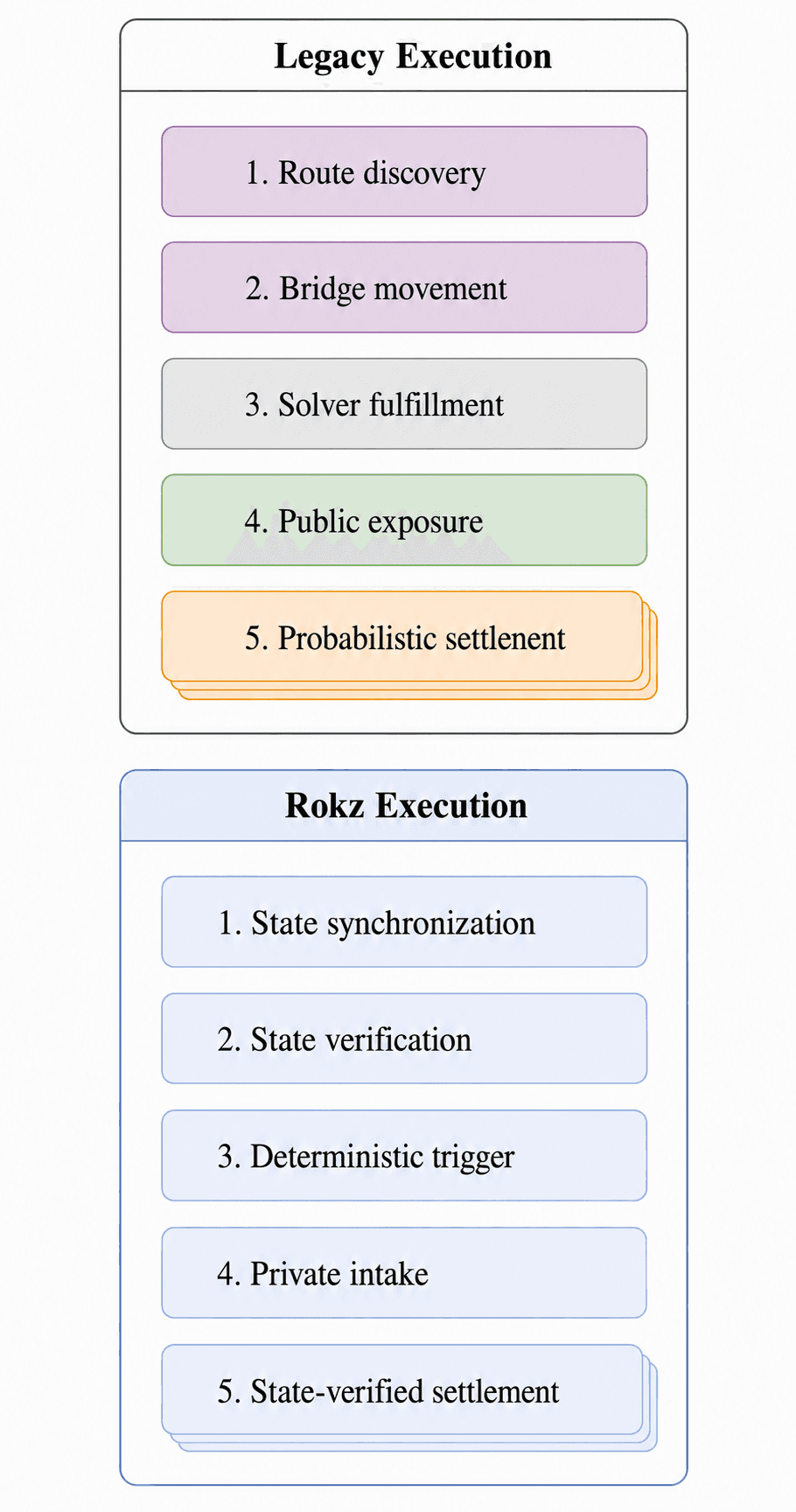
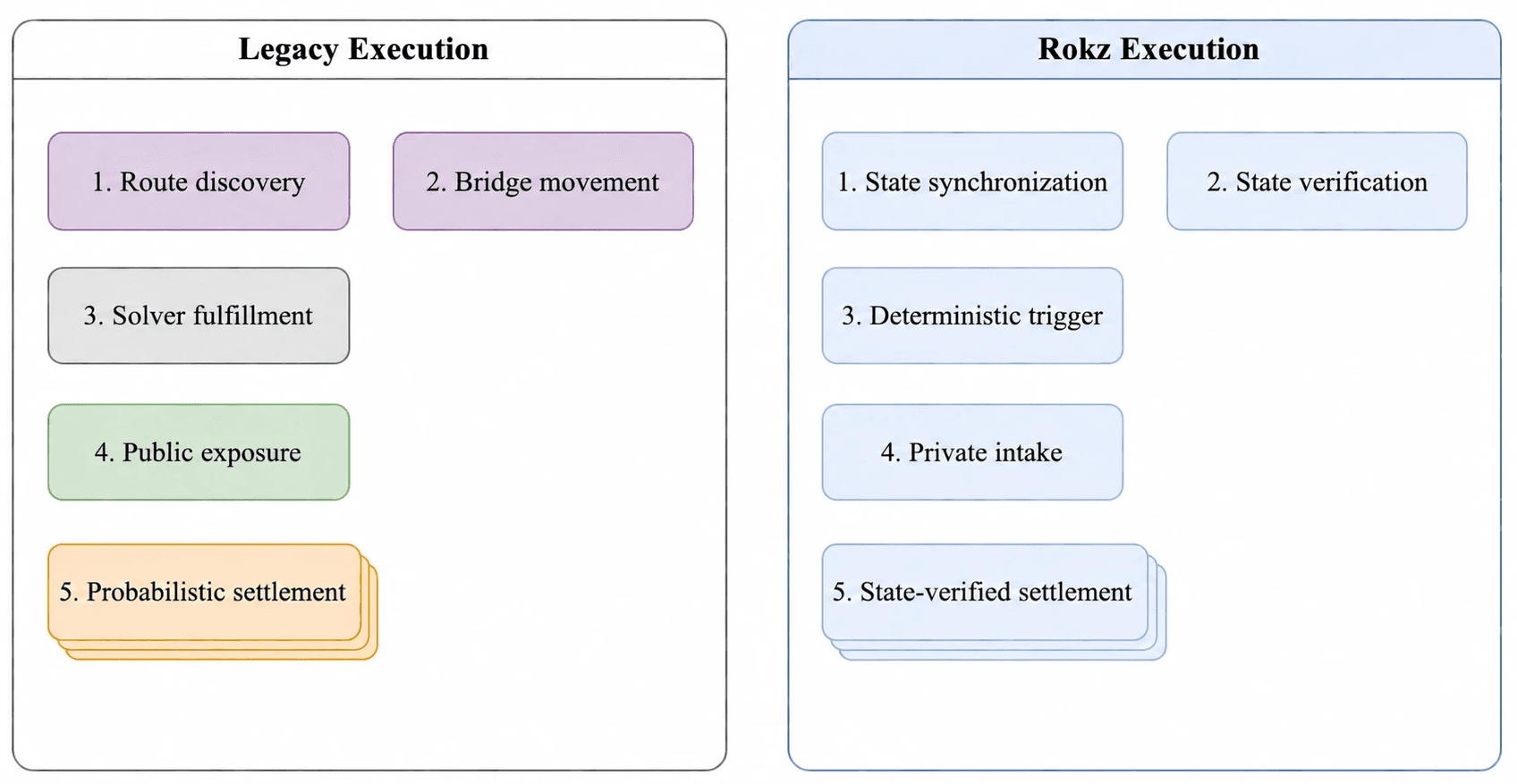
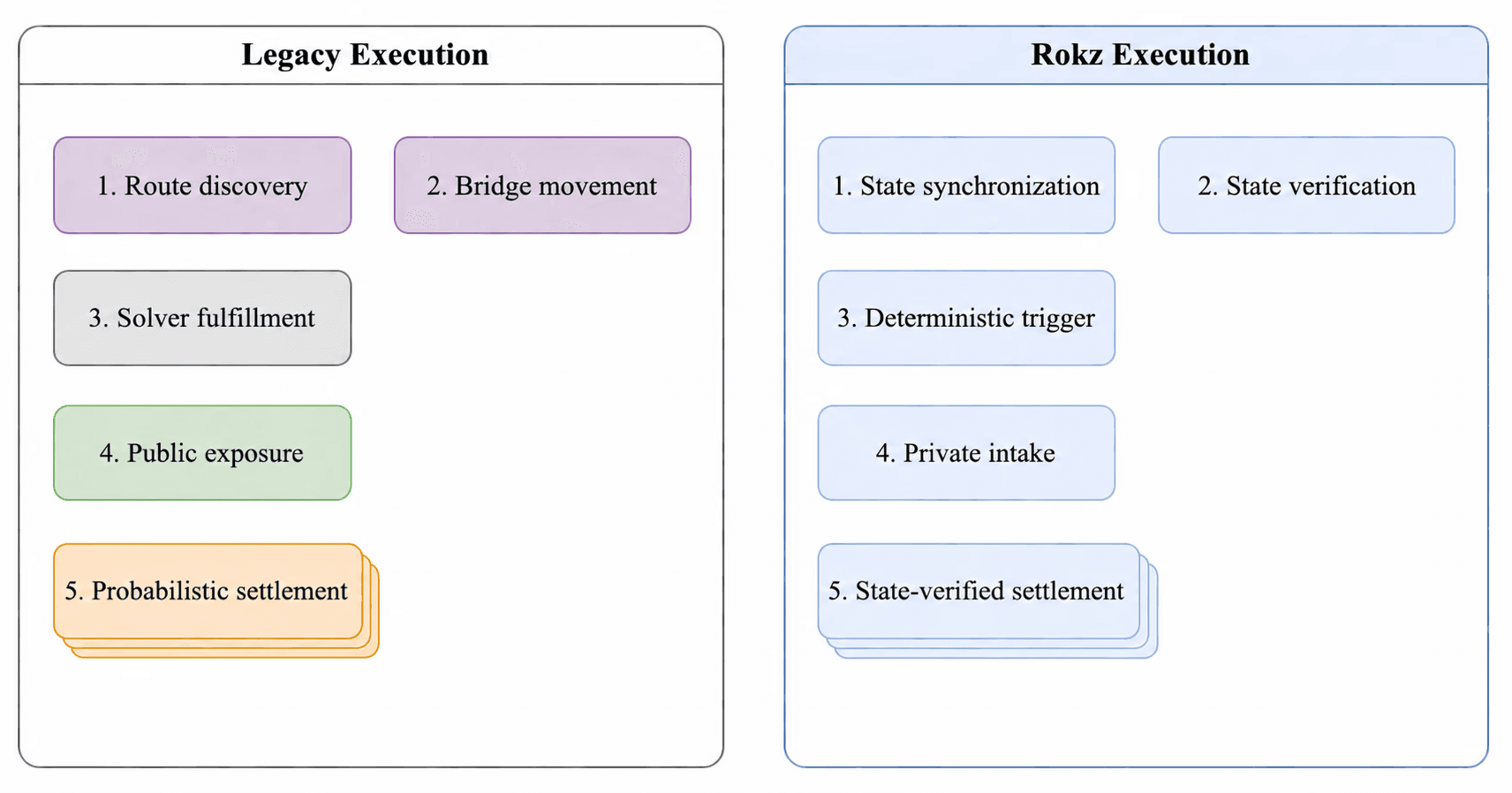
Rokz does not execute because a route exists. Rokz executes only when verified state confirms that deterministic settlement is possible. Execution is state-triggered, not path-dependent. Settlement is coordinated through verified state, not bridge-based transfer logic.
Rokz executes only when verified state confirms deterministic settlement. Execution is state-triggered, not path-dependent, and settlement is coordinated through verified state rather than bridge-based logic.
Core Components of the Coordination Model
The coordination model consists of five primary components:
Coordination Model Components
The coordination model consists of five primary components:
1.
State-aware transaction processing: Rokz does not treat a transaction as a blind instruction submitted into a volatile execution environment. The transaction is interpreted against live network conditions, liquidity availability, price constraints, finality assumptions, and execution feasibility before processing begins.
State-aware transaction processing:
2.
Synchronized cross-network state: Rokz Clients retrieve and synchronize state across networks that may not share the same virtual machines, finality models, consensus mechanisms, liquidity structures, or execution rules. The result is not a global chain, but a verified coordination layer across incompatible environments.
Synchronized cross-network state:
3.
Deterministic execution triggers: Execution begins only after state verification is complete. The protocol does not rely on a route, quote, or bridge transfer remaining valid after submission. It triggers native execution only when deterministic conditions exist.
Deterministic execution triggers:
4.
Native local execution: Rokz does not require liquidity to move into a separate protocol venue. Liquidity remains where it already exists, including native liquidity environments on Ethereum, BNB Chain, Solana, Avalanche, Arbitrum, and other supported networks. Rokz coordinates execution where liquidity already lives.
Native local execution:
5.
Protocol-level abstraction: Rokz abstracts chain-specific complexity away from users, applications, and institutions. Participants do not coordinate RPC endpoints, execution rules, liquidity venues, bridge routes, or settlement assumptions manually. They interact with a unified execution interface.
Protocol-level abstraction:
⟵ Scroll right/left ⟶
Coordination Component
What It Removes
State-aware processing
Blind transaction submission.
Cross-network state synchronization
Isolated state dependency.
Deterministic execution triggers
Route and quote uncertainty.
Native local execution
Bridge movement and liquidity migration.
Protocol-level abstraction
Chain-specific operational complexity.
1.
State-aware transaction processing: Rokz does not treat a transaction as a blind instruction submitted into a volatile execution environment. The transaction is interpreted against live network conditions, liquidity availability, price constraints, finality assumptions, and execution feasibility before processing begins.
State-aware transaction processing:
2.
Synchronized cross-network state: Rokz Clients retrieve and synchronize state across networks that may not share the same virtual machines, finality models, consensus mechanisms, liquidity structures, or execution rules. The result is not a global chain, but a verified coordination layer across incompatible environments.
Synchronized cross-network state:
3.
Deterministic execution triggers: Execution begins only after state verification is complete. The protocol does not rely on a route, quote, or bridge transfer remaining valid after submission. It triggers native execution only when deterministic conditions exist.
Deterministic execution triggers:
4.
Native local execution: Rokz does not require liquidity to move into a separate protocol venue. Liquidity remains where it already exists, including native liquidity environments on Ethereum, BNB Chain, Solana, Avalanche, Arbitrum, and other supported networks. Rokz coordinates execution where liquidity already lives.
Native local execution:
5.
Protocol-level abstraction: Rokz abstracts chain-specific complexity away from users, applications, and institutions. Participants do not coordinate RPC endpoints, execution rules, liquidity venues, bridge routes, or settlement assumptions manually. They interact with a unified execution interface.
Protocol-level abstraction:
Coordination Component
What It Removes
State-aware processing
Blind transaction submission.
Cross-network state synchronization
Isolated state dependency.
Deterministic execution triggers
Route and quote uncertainty.
Native local execution
Bridge movement and liquidity migration.
Protocol-level abstraction
Chain-specific operational complexity.
A route can discover liquidity, but it cannot make fragmented state deterministic. Rokz does not optimize routes. It removes route dependency by verifying state before execution begins.
A route can discover liquidity, but not make fragmented state deterministic. Rokz removes route dependency through state verification before execution.
The result is a model where isolated blockchain environments become operationally accessible through one deterministic coordination fabric.
The result is a model where isolated blockchain environments become operationally accessible through one deterministic coordination fabric.
Rokz does not transport liquidity.
Rokz does not custody user assets.
Rokz does not depend on bridges, wrapped assets, synthetic liquidity, external aggregators, or routing systems.
Rokz does not transport liquidity.
Rokz does not custody user assets.
Rokz does not depend on bridges, wrapped assets, synthetic liquidity, external aggregators, or routing systems.
Rokz coordinates deterministic execution directly across native liquidity environments through Rokz Clients.
On this page